Archive

Pakistan

We’re moving house.  In winter the gas supply on our street drops to almost nothing, meaning that last year we had three months of cold showers, cold food and constant shivering.  You wouldn’t think that being cold would be a problem in Pakistan, given the searing summer temperatures, but the lack of central heating and carpets, together with the surprisingly chilly winters, means that winter can be unpleasant too.

 One of the benefits of moving is that it enables us to paint the house however we like.  Pakistani landlords are wonderfully open to repainting, certainly compared to British ones, so the entire palette of paint colours is open to us to do as we like.

 And what marvellously daft names they have!  Acapulco Blue.  Cashmere Beige.  Antelope, Coriander, Pumice.  Wild Orchid.  Champagne – funny, that, in a dry country.  My mind boggles at the thought that someone, somewhere, is paid money to think up this kind of euphemistic nonsense.  Some poor sap is sitting in an office somewhere, desperately trying to think up new and exotic ways to describe the colour “red”.  So if you think your job is dull and unedifying, spare a thought for that guy.

 Anyway, the paint catalogues made me think about creating a palette of colours to describe some of the things we see in everyday life here in Pakistan.  So, without further ado:

Rickshaw Blue: the pale, blue-grey colour of the smoke clouds that rickshaws belch out as they clatter around the place.

Revolting Brown: the colour of the water after I wash my hands in it after a day in the bazaar.

Murree Green: the deep, lush, verdant green of the mountains of northern Pakistan in early summer.

Bougainvillea Purple: the vivid purple of the exuberant mounds of flowers which spill out of gardens all over Pakistan.

Kaghan White: the colour of the snow which clings to Pakistani mountains well into the summer.  Basically just white, but, you know, you’ve gotta make it sound fancy.

Loadshedding Black: just black.  Like when the electricity dies and all the lights go out.  For the fifth time that day.

 There must be more, but for now I need to go and choose some paint colours…

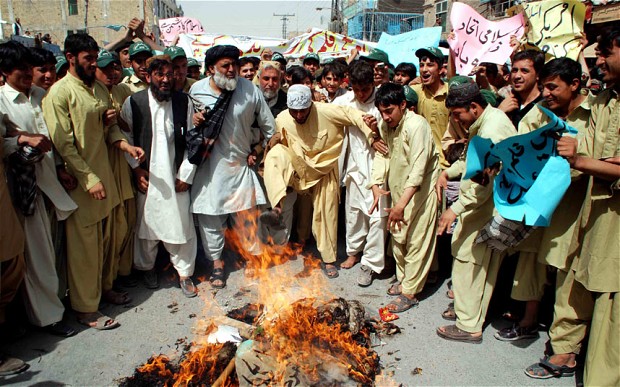
The film protests seemed to make people around the world think that Pakistanis are inherently angry people.  Such a small issue, they said, and such a disproportionate response!  The days of rioting seemed to confirm their suspicions that the population of Pakistan consisted of mainly angry people and religious fundamentalists, many of whom were also pretty angry.

I disagree.  The thing which strikes me most about Pakistani people is how hospitable and friendly they are.  I was struck by this when I arrived here and it continues to have an impact on me, more or less every day: when shopkeepers offer to buy me drinks and chat, when taxi-drivers and samosa-sellers try to refuse my money, when just about every man I meet in the bazaar engages me in polite and interested conversation.

Image

The amazing thing about this is that Pakistanis have every reason to dislike and distrust foreigners.  The land which is now Pakistan has been invaded by just about every military conqueror that history has to show: Alexander the Great, the early armies of Islam, the Afghans, the Persians, the Moghuls, and finally my ancestors, the British.  And even after that, when Pakistan was founded and people finally achieved their independence, the influence of world powers flowed across this land: the long proxy way against the Russians in Afghanistan and then the Americans, with their counter-terrorist operations and their drone strikes.

Think about it: if your country had lived through all of that, wouldn’t you be suspicious of outsiders?  And if those same outsiders were still bombing targets within your country, free from any restraint imposed by international law, mightn’t you be a bit angry?

But no, Pakistanis are invariably polite, welcoming and hospitable, despite the fact that foreigners have been meddling in their affairs for about two thousand years.  Angry Pakistan?  Painfully Polite Pakistan, more like.

Image

The TV screen caught my eye.  We were in a restaurant eating some delicious Pakistani food but suddenly the images of protesters waving placards and storming into embassies grabbed my attention.  Protesters in the Middle East had attacked US embassies in the Middle East in response to an amateur film which was critical of Islam and its prophet.  My first thought was whether the protests would spread further.

“Oh, don’t worry” said a passing waiter in response to my anxious question.  “People here aren’t too bothered about it”.

Well, he was wrong.  Boy, was he ever wrong.  A few days later protests exploded all over Pakistan.  Cinemas were burned, mobs roamed the streets stoning cars and attacking the police, and a large crowd attempted to storm the US embassy in Islamabad.  Our whole family stayed inside the house for four days.  Over twenty people were killed, largely in the southern megacity of Karachi.

These protests were criticised heavily, both within Pakistan and internationally.  Certainly, it is hard to see how torching a cinema and thereby destroying the livelihoods of many people is a valid way of expressing discontent.  They also seemed disproportionate to some – how could an amateur film, shoddily made in California on a tiny budget, possibly merit a response of such violence, a response which locked down Pakistan’s major cities for three days and which led to the deaths of so many people?

What people in the West largely fail to appreciate is that there is a lot of latent anger within Pakistan.  People here are angry about a whole range of issues.  Resources such as electricity, water and gas are limited.  Jobs are limited.  The population is growing rapidly and the pressure on both resources and jobs is increasing.  Prices are increasingly rapidly and salaries are not keeping pace.  Furthermore, it is widely recognised that Pakistan’s leaders are corrupt, with Transparency International claiming that $94 billion (yes, billion) have been lost due to corruption within the last four years.  People know this, and they also know that there’s not much they can do about it, and if I were in their shoes that knowledge would make me very angry indeed.

So yes, these protests were about the film, but the violent and angry response we all saw on our TV screens runs a lot deeper than that.  Lots of people here are angry and afraid.  When I caught up with a friend recently I asked him about how he saw things in Pakistan.  His response saddened me.  “Everyone here feels mental depression.  Some people can barely afford to eat.  Are you surprised that we are so angry?”.

Image

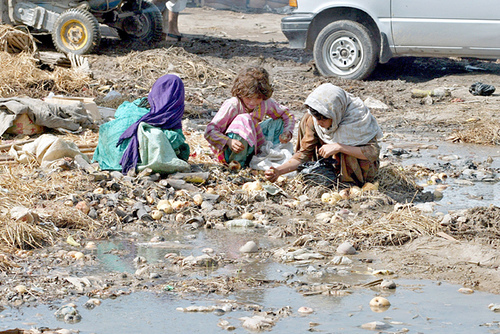
One of the challenges facing any Westerner living in Pakistan is dealing with poverty.  The difference in living conditions between us and a large chunk, even a majority, of the people we meet here presents a number of difficulties.  Of course, this is not specific to Pakistan – any person travelling from the West to any relatively impoverished country will come across poverty, such is the gulf between “the West” and “the rest” when it comes to wealth.

For me, this gulf was most starkly brought home when, early on, I was driving through our city with the kids in the back of the car.  Beggars regularly haunt traffic intersections, tapping on car windows and asking for money.  One of them, a young girl, pressed her nose up against the window where our 2 year old son was sitting.  It occurred to me that only a thin piece of glass separated them – but the gap between them in terms of wealth, life expectancy, job prospects, overall prosperity, in short every measure of quality of life – that gap was immense.  One child can expect little more than a lifetime of poverty and hardship, forced to eke out a living from the scraps of others, while the other child, possessed as he is of a Western passport, can expect a lifetime of relative comfort and entitlement.  A few millimetres of glass represented, for a few fleeting seconds, a division of heartbreaking width.

What’s a Christian to do?  This is not at all an easy question and it weighs heavily on the conscience.  While I cannot offer an easy answer, some pointers might be of use.

1. Doing nothing is not an option.  Christians are called to minister to the needs of others and in this regard we have the example of Jesus who constantly ministered to those in need.  If we simply turn our back and ignore the plight of the needy then our faith is nothing but tedious hypocrisy.  Poor people can’t eat sermons; holy words don’t put a roof over their heads.

2. Handing out money is not the answer.  This is an easy way out, enabling the wealthy to assuage their consciences by dishing out a few rupees here and there.  In doing so we effectively purchase for ourselves a few minutes of peace of mind, happy that we have done “something” for “someone”.  Well, maybe we have, and maybe we haven’t.  Those rupees may mean that a beggar eats, or they may mean that their gangmaster makes even more money for himself.  Sad, but true in many parts of the world.

3. Love and respect are worth more than money.  I try to chat to people begging from me, asking them what their name is and engaging them in conversation.  Sometimes they don’t care, eager only for money, but on a few occasions their faces have lit up as they discover that someone sees them as a precious human being rather than just an irritation.

4. Word and deed need to go together.  As I said before, mere words do not fill empty stomachs.  We try to hand out little packets of biscuits as well; at least the beggar will be able to have a little something to eat.

Ultimately it is the root causes of poverty which need to be tackled.  It is not the fact that kids beg at traffic intersections which really angers me, it is the brokenness in human institutions and societies which results in kids having to beg at traffic intersections.  Many of the beggars in our city have fled from warfare in the tribal regions; others are destitute because rich landowners throw them out or are so greedy for money that they loan money at prohibitive interest rates, resulting in entire families being forced onto the poverty line so that a rich man can build a bigger house.  This problem has to be tackled wholistically, taking the whole situation into consideration.

Martin Luther King once said that the essence of Christian love was to pick people out of ditches and set them back on their feet – and, eventually, to tackle the injustices which result in people being throw in the ditch.  We need to do both.  It’s a big job, but thankfully we have a big God, too.

Living in Pakistan causes one to encounter creatures which, in most Western countries, would normally kept in glass boxes and poked at by people with notepads and white coats.  During our first few months in Pakistan we came distressingly close to a number of creepy-crawlies which we had no desire to meet on a personal basis: gigantic furry spiders, rats, bats, and a wide range of bugs of varying colours and sizes.  But none of these, not even the bat flying around our bedroom at five in the morning, came close to the trauma of the epic tale of the Scorpion In The Sink.

Scorpion in the sink

As previously noted, I come from the UK, a country not noted for the savagery of its wildlife.  Unless you happen to be bitten by one of the few remaining adders (our only poisonous snake) or attacked by an overly territorial seagull there are really very few risks from wildlife.

Although I can think of a few evil-minded cats that I would gladly drop-kick over a hedge.

 In Pakistan things are different.  Snakes, scorpions, bats, flying squirrels and cockroaches are just the beginning.  Bears, wolves and snow leopards roam the northern mountains, elusive and rare but perfectly capable of tearing into a soft, puny Westerner like a teenager ripping into a hamburger.

 So when I went to brush my teeth in the evening and encountered a scorpion perched in the middle of the sink I was, let’s say, alarmed.  In fact no, let’s tell it like it is: I yelped like a girl and ran.  How did it get there?  It was too big to have climbed up the drainpipe so it must have dropped down from the ceiling.  But then it could have dropped anywhere – onto our bed, onto a plate of food, onto our faces while we were sleeping…

No, best not to think about it.  I administered a few whacks with a slipper and disposed of it.  Hope there aren’t any others around…


The first time I came to Pakistan I found myself idly gazing out of the windows of taxis and buses as we whizzed around this new and bewildering country.  The sheer variety of Pakistani traffic dazzled me – horses, donkeys, goats, even camels, were sharing road space with Land Cruisers and shiny new Corollas.  And the buses!  Multicoloured, moving works of art, glinting in the sun and rolling up the Karakoram Highway bearing loads of gorgeous Pakistani fruit.  Never has staring out of a car window been so relentlessly entertaining.

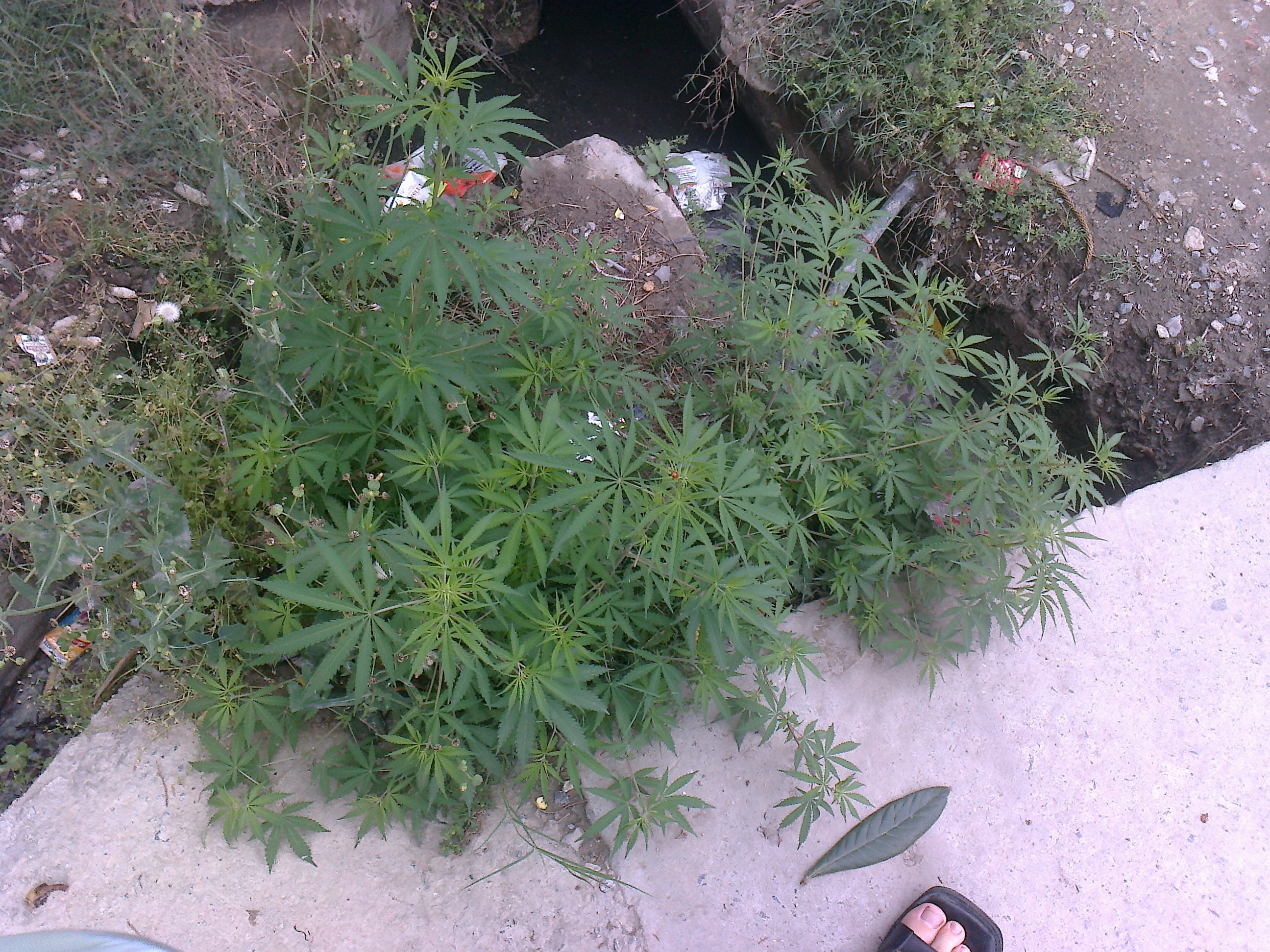
And yet one thing perplexed me.  When driving around Islamabad I could see one particular plant almost everywhere I went.  Lush, green, with spiky leaves – it brought back memories of posters on the walls of some of the guys I knew at college.  The kind of guys who went on weekend breaks to Amsterdam, listened to Bob Marley, and seemed relaxed most of the time.  Very relaxed.

Yes, it was weed.

This stuff grows everywhere in the city in which we live.  Everywhere.  Entire rows of the stuff, eight feet high.  Whole blocks of the city are hedged in with marijuana.  If those relaxed and strangely fragrant guys from university came out to Pakistan I think they would have a very chilled-out trip.

I found this very odd at the time, and I still do – that this stuff grows wild with such exuberant profusion, and spreads itself around the place so successfully, in an Islamic country which obviously frowns on drug usage.  But then it makes me think that perhaps it might be a good business opportunity – it’s essentially free, and people in Amsterdam pay all kinds of money for it, and long-haired people relaxed people in California are very enthusiastic about its “medicinal” properties, right?  Now, if I could just find a way to get it past the sniffer dogs at Heathrow…

Image

One night in June I started to feel pain in my stomach.  This is common around here, what with the tap water containing more bacteria than a microbiologist’s petri dish, so I thought little of it.  When the pain got worse, and then even worse, I started to wonder if I should do something about it.  And when it became unbearably painful I asked a friend to drive me to a hospital in the mountains, some three hours away.  That journey, over bumpy mountain roads in the middle of the night with me vomiting into a bucket every fifteen minutes, is a story in its own right.

                 To cut a long story short it ended up being a very serious problem indeed which required some particularly invasive and unpleasant surgery on my intestines.  This required a two-month period of convalescence in the UK, as it was 45 degrees in our home city in Pakistan, a temperature not exactly conducive to recovery from a major illness.  We flew home and spent two months resting, eating good food, visiting family and friends, and trying to persuade people that we couldn’t wait to return to Pakistan again.

And now we’re back.  It’s great to be home.  Normal service, whatever that means, will shortly resume on this blog…

“Ok, now that we’ve covered all of the basics of driving in Pakistan, here’s the positive news.  If you’ve ever driven in a Western country you will find it very liberating to drive here, because you can do anything you like and nobody will complain.

“What’s that?  You’re from the UK?  Good country, good country.  My cousin lives in Bradford, do you know him?  No?  How about my uncle’s brother’s wife’s son in Glasgow?  Not him either?  Wow, you don’t know anyone.

“Well, compared to the UK driving here is a lot of fun.  No speed cameras, no numberplate recognition cameras, nobody giving you a ticket if you decide to do a U-turn in a busy main road and going back the way you came.  Honestly, as long as you do manoeuvres slowly and don’t smash into anyone you can get away with just about anything.

“Sometimes you come across speed cameras, on the motorways for example.  But when you think that a speeding ticket costs the equivalent of £3 it’s not too big a deal.  Just view it as a toll and continue driving as fast as you like.  That’s what most people here do.  Wonderfully liberating, isn’t it?  The other good thing is that car repairs are incredibly cheap; you can replace a head gasket for £12 and brake pads for £20.  No more huge repair bills like you get in the UK.

“Ok, that concludes our driving course.  Now, could you possibly give me a lift back home?  Just watch out for that army truck reversing down the middle of the road at high speed, and try not to hit that donkey that’s by the…oh.  Oh dear.  Oh dear me, that really is very messy.  Oh dear, here comes the owner, and he doesn’t seem very happy.

“Ok, time for a practical lesson in evasive driving.  Let’s be off, shall we?

“Great, well done for parking correctly.  You managed to leave a whole three feet between your car and the kerb which is ideal.  As your parallel parking skills are already perfect I think we should move on to the rules of driving in Pakistan.

“There aren’t any.

“Ok, next topic.  Let’s talk about…what’s that?  You don’t believe that there aren’t any rules?  Of course it may seem strange to hand driving licences and car keys to millions of people, enabling them to hurtle around the place in heavy metal boxes at implausible velocities without any kind of oversight or regulation, but just imagine how much work it would be to operate speed cameras, to enforce lane discipline and make seat belts mandatory and check that people replaced their car tyres when they were worn down!  Too much work, that’s how much.  Much easier to leave people to their own devices.

“Anyway, let’s do a quick quiz.  Which of these is not a common hazard on Pakistani roads?  Dogs, donkeys, flocks of goats, camels, potholes big enough to contain a couple of watermelons, police roadblocks, army roadblocks, or lorries having a wheel changed right in the middle of a busy main road?  Any ideas?  No?  Well, trick question!  They’re all a hazard.  Might want to bear that in mind the next time you drive home in the middle of the night.  Oh, and there aren’t any street lights either, before you ask.

“Right, let’s summarise what we’ve learned.  Firstly, there are no rules.  Secondly, try not to drive into a camel.  Ok, having completed our course in Pakistani driving theory, let’s move on.  Why don’t you pull out and drive away?  Just try not to drive into that flock of goats.  Getting goat hair out of the radiator is a nightmare, believe me.

Salaam aleikum, and welcome to my driving school, Sohail’s School of Improbable Motoring.  Ok, here are the keys.  Feel free to drive off whenever you like.

“Very good, I note that you pulled away from the kerb and drove off without checking in your mirrors.  See, in Pakistan, it’s the responsibility of the person behind you to stop, so if you pull out rashly and they smash into you, it’s their fault.  Checking in the mirrors before driving off is a waste of time, so well done there.  Right, if you could just swerve dangerously around that pothole, we’ll be on our way.

“Notice anything?  No?  Not even that motorcyclist behind us, waving furiously and making rude hand gestures?  You almost hit him when you swerved, but it doesn’t matter, a motorbike’s smaller than a car so it’s his problem.


“Ok, now that we’ve got to the end of the road I can’t help but notice that your driving is flawed.  Your clutch control, steering, gear changes and speed are all perfect, but you haven’t beeped your horn once.  Not once!  Do you know how dangerous that is?  Without beeping your horn how will people be able to see you?  They’ll never look, so it’s up to you to make yourself visible by leaning on the horn.  Also you may need to say hello to friends, or to tell a rickshaw to move over, or to tell someone that their boot just popped open and all of their luggage is strewn across the road.  Believe me, your horn is the single most important part of your car.

“Splendid, you found it.  No, you need to lean on it more.  No, more.  There, that’s it.  If a crow in a tree six hundred metres away flies away in alarm you’re getting the hang of it.  Oops, swerve around that camel, won’t you?  Oh dear, you clipped its leg and broke one of your wing mirrors.  Doesn’t matter, nobody uses them anyway.

“Right, if you could just park here we’ll move on to your second driving lesson.  Might need to beep the horn a bit to get that donkey to get out of the way.

Design a site like this with WordPress.com
Get started