IMAG0389edit

Time passes quickly.  My daughter is nearly two already.  I spend a lot of time with my family, one of the biggest blessings of the kind of work I do, and I’ve seen every stage of her life at first hand.  The birth, the first few weeks, learning to roll over, to crawl, to walk, to laugh – I’ve seen it all as it happened and it has brought me and my wife a lot of joy.

She’s nearly two, and at the moment one of her favourite things is swinging on the swings.  Friends of ours have a set in their front garden and she’s taken to grabbing me by the hand and pulling me towards them.  “Dat one!” she squeals excitedly, “dat one!”, pointing to the swings and hopping up and down with joy.

Today I pushed her on the swings for twenty minutes.  Whenever I paused she would call anxiously to get me to continue.  “Poosh!”.  “POOOOOSH!”.

She’s nearly two already, and everyone tells me to treasure each day, that time passes so quickly, that she’ll be grown up before I know it.  It’s true, of course.  One day she’ll be grown up, may get married, may have children of her own.  I hope that when that day comes I’ll be able to look back and remember the little girl with blue eyes, swinging on the swings with such joy, her golden ringlets streaming in the breeze.

When people hear that we live in Pakistan they tend to take a deep breath and roll their eyes.

“That must be stressful” they often say.

They’re often right.  Everyday life in Pakistan, as in many other developing countries, features a pretty high level of stress.  More or less everything is more difficult than it is in the West.  Things that are done online in the West – paying bills, ordering groceries, changing car registrations – is done in person in Pakistan, which means a trip to the bank and a good half hour (minimum) of your time.  Then there’s the stress and expense of renewing visas (meaning that permission to stay in Pakistan is conditional on the whims of the government and can be withdrawn at any time), and the power cuts (sometimes for up to 20 hours), and the heat, and a permanent level of anxiety about security – especially since a group of foreign tourists were recently killed in the mountains north of here.

And then there’s the additional stress.  Recently, for example, we have faced:

– Our daughter being sent for a CT scan to check for suspected hydrocephalus (false alarm, thankfully).

– Our son catching a virus which gave him a high temperature, which meant that he couldn’t sleep and we had to stay awake fanning him with a piece of cardboard all night.

– My wife slipping on wet tiles and pulling several muscles, which incapacitated her for two days.

– Me sleeping awkwardly on my right arm which effectively paralysed it for a day.

– One 20hr power cut and another 15hr one, which meant no fans and no water to take showers as we couldn’t run the water pump, and…

– …temperatures topping 40 degrees Celsius.

I write this not in an attempt to gain any kind of kudos or respect for the things we have to put up with.  I write this because there may be people who are thinking of coming to Pakistan to work for an NGO and I’d like them to know in advance some of the things they might have to deal with…

When people hear that we live in Pakistan they tend to take a deep breath and roll their eyes.

“That must be stressful” they often say.

They’re often right.  Everyday life in Pakistan, as in many other developing countries, features a pretty high level of stress.  More or less everything is more difficult than it is in the West.  Things that are done online in the West – paying bills, ordering groceries, changing car registrations – is done in person in Pakistan, which means a trip to the bank and a good half hour (minimum) of your time.  Then there’s the stress and expense of renewing visas (meaning that permission to stay in Pakistan is conditional on the whims of the government and can be withdrawn at any time), and the power cuts (sometimes for up to 20 hours), and the heat, and a permanent level of anxiety about security – especially since a group of foreign tourists were recently killed in the mountains north of here.

And then there’s the additional stress.  Recently, for example, we have faced:

– Our daughter being sent for a CT scan to check for suspected hydrocephalus (false alarm, thankfully).

– Our son catching a virus which gave him a high temperature, which meant that he couldn’t sleep and we had to stay awake fanning him with a piece of cardboard all night.

– My wife slipping on wet tiles and pulling several muscles, which incapacitated her for two days.

– Me sleeping awkwardly on my right arm which effectively paralysed it for a day.

– One 20hr power cut and another 15hr one, which meant no fans and no water to take showers as we couldn’t run the water pump, and…

– …temperatures topping 40 degrees Celsius.

I write this not in an attempt to gain any kind of kudos or respect for the things we have to put up with.  I write this because there may be people who are thinking of coming to Pakistan to work for an NGO and I’d like them to know in advance some of the things they might have to deal with…

I was driving through Islamabad recently when a traffic policeman pulled me over.  As a moderately  conscientious motorist who has never received a ticket or fine nor been in any kind of significant accident my brushes with traffic policemen are infrequent.  In fact in Pakistan the only reason I ever have to speak with one is either because they are bored and want someone to chat to, or, as happened to me recently, they want to borrow a pencil.

I didn’t have one.  He seemed confused.

“If you don’t have a pencil, how do you write?” he asked.

I attempted to respond that although I liked writing I tended to do so with a computer, and, either way, that I tended not to do any kind of writing while driving, but he laughed and waved me on.

Anyway, on this particular day the policeman seemed moderately irate.  This is odd, because in my experience Pakistani traffic policemen are courtesy itself.  I greeted him and asked him what the matter was.

“You were talking on your phone” he said.  This was undeniable.  A friend had called about a meeting later in the day and I had answered.  Though illegal in the West I had no idea that such a thing was also illegal in Pakistan.

I told him that I was terribly sorry and that I had no idea such a law existed.  He flipped to the appropriate page in his book of fines and showed me the small print.  There it was – “talking on mobile, 300 rupee fine”.  Bang to rights.  Caught red handed.  Busted.

“I’m so sorry, sir” I replied.  “You’re quite right.  I ask for your forgiveness”.

He seemed dumbstruck.  He scratched his head in confusion.

“You know I have to give you a ticket, right?” he said.

“Of course, you are quite right.  It is your job.  I am sorry to have caused you such bother”.

He didn’t know what to do.  People in Pakistan generally argue in this kind of situation.  Minor infractions lead to major disagreements, with lots of gesticulating, shouting, and usually bystanders getting involved for no apparent reason other than their love of a good show.  Nobody ever apologises, and certainly nobody ever asks for forgiveness.

Nobody.  Ever.

“Ok, next time” he said, with a confused face and perhaps the hint of a smile.  “Don’t do it again”.

When I sit in front of my laptop I feel like a character from Star Trek.  Within this small device, with its tiny green LED signifying an active internet connection, the entirety of human knowledge is at my fingertips.  In the same way that characters from sci-fi TV programmes used to do, with just a few key presses I can bring up more or less any kind of information imaginable.

I can read about Byzantine naval tactics, the history of Wolverhampton Wanderers football team, the current weather in Santiago or Kuala Lumpur.  The internet will inform me of the current price of a barrel of North Sea oil, of any projected delays to Air Canada flight 868 from Toronto to London, of the precise distance from Earth to Venus.  I can, if I so choose, learn the motto of Aitchison College Lahore, the diameter in millimetres of a Major League baseball, the precise altitude of the city of Ulan Baator, Mongolia.  I can do anything.  Anything.  The whole of human knowledge, the sum total of thousands and thousands of years of studying, learning, pondering, living, playing, exploring, measuring, developing, advancing – it’s all here.  All of it.  A fact which, in times past, would have taken the chief scientists of the day months of study, can be mine within a few seconds.  Even thirty years ago someone would have had to find a book and look it up, but even that minor inconvenience is spared me thanks to the internet, and Wikipedia.  The kind of technology that sci-fi writers would have dreamed of is here and in our hands, even, thanks to smartphones, in our pockets.

So why, when I sit in front of my laptop, invariably ignore this vast accumulated wealth of knowledge and wisdom and revert to looking at Facebook and watching funny videos of babies dancing?

I’m lazy, is the honest answer.  For shame, for shame…

Image

Introducing the all-new dieting craze that is taking Pakistan by storm, we are proud to present the Dodgy Kebab Weight-Loss Diet!

This revolutionary new concept in weight loss, developed as a partnership between companies in India, Pakistan, and in specialised dieting centres known as Fast-Food Outlets Of Dubious Hygiene (FFOODH) around the world, the Dodgy Kebab Weight Loss Diet enables you to lose weight rapidly, dramatically, and with only a minimum of violent illness!  This phenomenon is taking South Asia by storm, enabling many people, mostly foreigners with puny immune systems, to achieve that fashionable thin-as-a-rake look!

Here’s how it works:

1. First, go to a vendor of dodgy kebabs.  In Pakistan these can be found in any kind of settlement and come in a variety of types.  Minced beef will either be shaped onto a skewer or slapped flat, before being dunked in Cooking Oil Of Dubious Cleanliness, cooked, and served to you on bread with a knowing wink from the kebab salesman.

2. Next, eat the kebab.  This will be pleasant, since they are always tasty.

3. Now comes the difficult part: waiting.  It can be frustrating to wait, knowing that a sylph-like figure is just around the corner, but have patience!  The moment will come.  And when it does, your body will tell you.

4. Finally, rush to the toilet frantically, clutching at your backside, and let nature take its course.

You may need to repeat steps three and four.  You may need to repeat them many, many times.  But don’t worry; every time you repeat the steps you will get a little bit thinner!  After only a few days your body will be slim and ready to fit into any kind of clothing you can think of.

But don’t just take it from us, read some testimonies from satisfied customers of the Dodgy Kebab Weight-Loss Diet!

 “I couldn’t believe how easy it was to lose four kilos of body weight!  Admittedly I couldn’t move more than five metres away from a toilet for a whole week, but that’s a small price to pay” – Danish, Karachi.

“Forget about the Atkins Diet, regular exercise, or pills – just eat a dodgy kebab and you’ll lose pounds and pounds in a single day!  Do you have any toilet paper I could borrow?” – Irfan, Abbottabad.

 “I really would recommend the Dodgy Kebab Weight-Loss Diet.  It really helped me to – oh dear, excuse me, I have to dash to the bathroom…” – Mohammed, Rawalpindi.

One thing you will rapidly notice after coming to Pakistan from the West is that power cuts are a fact of life here.  Back home in the UK power cuts happen very occasionally, perhaps two or three times a year, and usually for not more than a few seconds.  Once the power went for half an hour and people on our street were so startled that they went out into the road to see what the problem was.  We spent more time with our neighbours on that single day than we would normally in a whole year, which, when I come to think of it, is rather sad.

 But I digress.  I’m writing about power cuts, not the lack of a concept of community in modern Western culture.

 In our city in Pakistan the electricity goes out several times a day, and when it goes out it stays out for an hour or more.  In an average day we have power cuts between 6am and 7am, 9am and 10am, 12pm and 1pm, 3pm and 4pm, 6pm and 7pm, and between 9pm and 10pm.  That’s a total of 6 hours of the day – and those are just the waking hours; power cuts also happen at night.

 And that’s just a normal day.  Occasionally, when there are major roadworks in the neighbourhood or when a transformer blows, the power can be cut for several hours at a time.  The longest cut we ever experienced was when the transformer on our street exploded with a blinding flash: we were without electricity for a full 12 hours.

 I don’t know what the reasons are for Pakistan’s epic electricity shortage, other than what I read in the Economist and elsewhere, which is that some rather important people don’t pay their electricity bills.  This is pretty tragic because, domestic inconvenience aside, power cuts play havoc with Pakistani industry.  Can you imagine running a factory profitably when your machines will only be able to function for two-thirds of the day?

 For us this is an inconvenience which can mostly be avoided by adjusting our schedule and by installing a UPS – essentially two car batteries connected to a small box which flicks over when the power goes, enabling us to run a few crucial appliances (lights and fans) on battery power.  Not a big deal, although it does make us envious of how easy life is in Western countries.  The things we take for granted, eh?

I’ve had enough of hearing about the Boston marathon bombings.  Not because they weren’t terrible – they were.  Not because I don’t have sympathy for those killed and injured, and their families – I do.  My reason for being thoroughly fed up with the incessant stream of updates is that they seem to indicate that some human lives are worth less than others.

 Three people were killed in Boston on April 15th and many more injured, some of them seriously.  That’s horrible, but I want to put this in some kind of global perspective.  The day afterwards, April 16th, some 42 people were killed and 257 more injured in a series of bombings in Iraq.  In Syria scores of people, including women and children, are dying by the day.  In Pakistan only yesterday eight people were killed in in a string of attacks.  These events made the news – but only just.  They attracted barely a fraction of the attention that was lavished on the city of Boston which suffered far fewer casualties.

 The fact that the Boston bombings were out of the ordinary was a factor, of course.  Terrorist attacks on mainland USA are rare, whereas bombings in many parts of the world, including Iraq, Syria and Pakistan, are depressingly commonplace.  But even so, the disparity in coverage concerns and depresses me.  It’s hard to escape the notion that the value of a human life varies from country to country.  It reminds me of the dark joke which came out of the 2005 Indian Ocean tsunami, when people protested the disparity in media coverage by saying “3 Americans killed in tsunami”, implying that the other 230,000 of different nationalities didn’t matter so much.

 It’s probably naïve of me to hope that one day people might care as much about a street kid in Karachi or Kenya as they do about marathon runners in Boston, but I refuse to submit to the unspoken understanding that the life of one is worth more or less than that of another.  The whole world is worthy of our attention, not just the areas in which English is spoken, iPads are purchased, and people drink Starbucks.

Recently I went to the bank to be added as a signatory to a bank account.  This seemed like a reasonably straightforward transaction, especially as the bank was more or less empty at the time.  Name…check.  Signature…check.  Passport number…fine.  Witnesses…oh.

Two people had to sign their names as witnesses of the transaction, said the helpful bank employee, a smartly dressed young lady.  Can you do it yourself, we asked?

“No, sadly not.  For two reasons.  Firstly, because I am a bank employee”.

Oh, that’s fair enough.  Probably some kind of anti-corruption measure, which is sensible.  And the second reason?

She coughed quietly and looked straight at me.

“Because I am a woman”.

Image

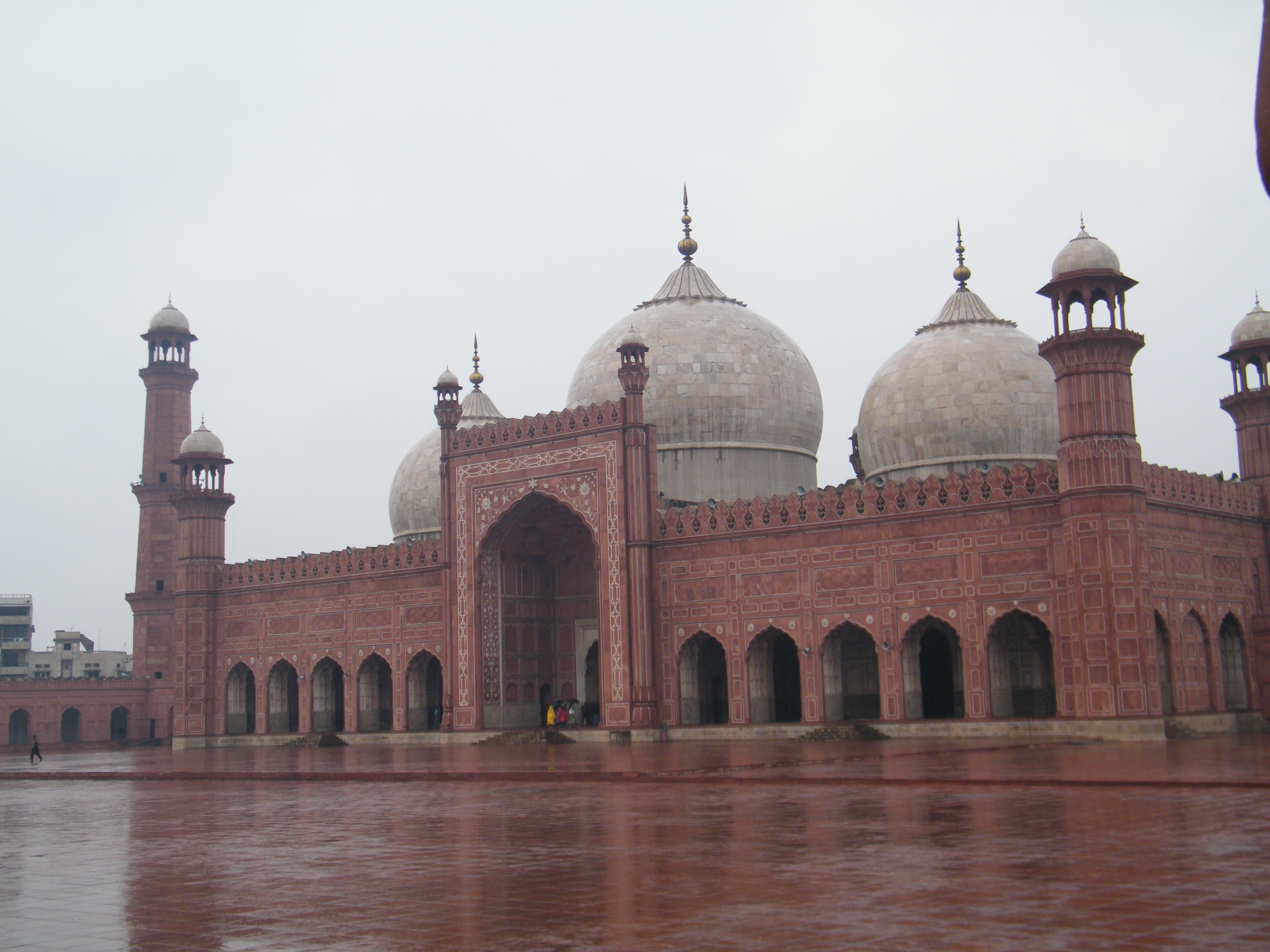
Here’s a confession: I have been to Lahore a total of five times and only recently, on my fifth trip there, did I get round to visiting the Badshahi Mosque.  This is strange, seeing as it is one of the premier historical attractions of Pakistan and I am keenly interested in history.

Never mind, though – despite my tardiness I eventually got around to visiting it, and I wasn’t disappointed.  Its size alone makes it stand out – it is vast, with a courtyard large enough to accommodate some 95,000 worshippers.  It was the largest mosque in the world for over 300 years, until it was overtaken by the Faisal Mosque in Islamabad.

I don’t want to add much more – if you want to learn about it, head over to Wikipedia in the first instance – but I can confirm that it is large, beautiful, a remarkable piece of Moghul engineering, and that we were welcomed warmly when we visited.  Hopefully the above photo will speak for itself…

Design a site like this with WordPress.com
Get started