Archive

Pakistan

51a365676

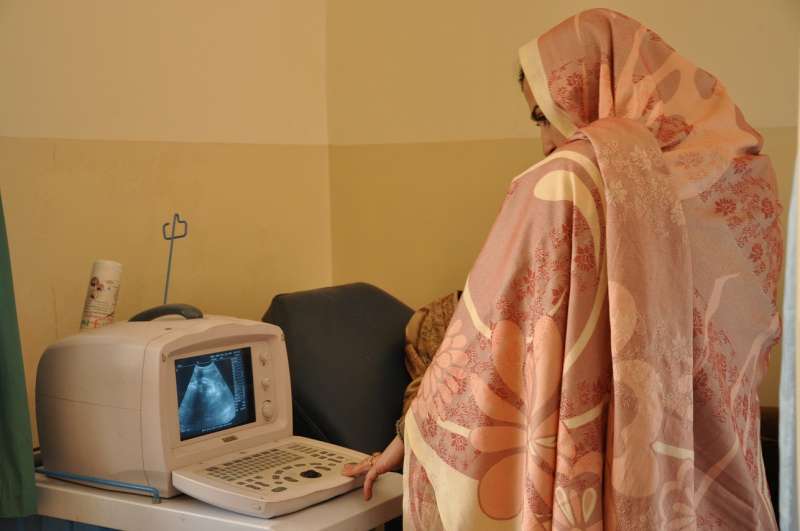
One of the challenging aspects of having a baby in Pakistan is that it is culturally inappropriate for a woman to be obviously pregnant.  Pakistan is a conservative society and it is generally held that pregnant women should remain indoors.  I’m not sure whether this is because the sight of a pregnant belly is considered somehow shameful or because women considered to be in such a fragile condition are expected to remain at home in order to be protected – but whatever the reason, pregnancies are generally concealed from public view as soon as they become obvious.

This is rather odd, of course, since Pakistan as a nation deeply welcomes and treasures children in a way that Western countries have stopped doing.  When eating at restaurants the waiters are more than happy to take care of our kids while we finish our food at a more leisurely pace, while the sight of one of our blonde-haired children is enough to make passing ladies stop and pinch their cheeks admiringly.  Yet this aspect of Pakistani culture is entrenched, and when I announced to our landlord that we would soon be welcoming our fourth child, I did so in hushed tones, as though quietly informing him that I had a bottle of whiskey hidden in my car.

“Our fourth child will soon be joining us” I said quietly one morning.  “So please forgive us if there is more noise than usual”.

“Ah” he said, gravely but kindly.  “I quite understand”.

We exchanged knowing nods and shook hands as though engaging in some dodgy business transaction, and went our separate ways.

The thing is, we can’t afford for my wife to retreat into the house and become a hermit for the last trimester of her pregnancy.  We have jobs to do, children to take to school, shopping to manage, and nobody to support us – no nearby relatives, no mother-in-law to move in and take charge for three months as a Pakistani mother-in-law would do.  So we were forced to disregard this aspect of Pakistani culture – regretfully, of course, since we do everything we can to respect local customs, but what else could we do?

So for the final three months of the pregnancy we went about our business as though guilty of some weird secret, covering up the increasingly conspicuous physical evidence of our child’s imminent arrival with baggy clothing and hurried shopping trips.  I doubt we fooled anyone.  It’s astonishing how perceptive Pakistani people are, particularly women.  I’m not too concerned, though.  Our child’s quickening in the womb was made evident not just by my wife’s swelling belly, but in our smiles, and in our trepidation, and in a quiet and private sense of joy.

We were sitting in our bedroom on Sunday afternoon when the rain came.  It came suddenly, without warning – from sunny skies to a torrential downpour in two seconds, as though God had flicked a switch and opened the heavens.  In an instant the sky turned dark as black clouds hovered menacingly overhead.  Sheets of water cascaded from the sky, and screams of delight echoed around our neighbourhood.

allahbad-kids_1434015i

In the UK people complain about rain.  However, in Pakistan, especially during the sweltering summer months, it is deeply loved.  The intolerable heat and humidity vanish in an instant as the clouds break: a cool breeze blows through the houses and people feel, for the first time in days, that they are able to breathe again.  Rain is wonderful, a gift, an occasion for rejoicing.

I dashed downstairs with the children.  Giggling loudly, they ran into the street, jumping up and down for joy.  Our landlord, normally a sober and respected doctor, took off his shirt and danced in the street.  His son and my son jumped on their bikes and went careering up the road, steering through immense puddles and overflowing gutters.  Our neighbours were out as well, playing in the puddles with their sons and daughters.  One even brought out his hosepipe and sprayed our kids as they ran past, laughing wildly.  We were drenched, all of us, instantly and completely, as though we had just walked through a waterfall.

We got to know our neighbours: the man from two houses up who was playing with his daughter, the respected old man from across the road who smiled indulgently at my daughter kicking water from a puddle, the teenaged girl from a few houses down who walked silently up and down the street with her iPod plugged into her ears, smiling quietly as the rain poured down her face.  Later our landlord’s wife brought out a plate of fresh pakoras and another of doughnuts which the children rapidly devoured before running back into the street.  Everyone was smiling, the habitual hassles of Pakistani life dissolving in the rain.

One of the great strengths of Pakistan is its communities.  Though largely lost in the West as we become ever more individualistic, community still exists here.  The social network is strong: neighbours advise us to put hats on our kids during the winter, recommend good schools or doctors, share festivals together.  We say “salaam-aleikum” to everyone we meet, and they do the same to us.  It would be strange not to.  In the UK we look largely to the government to provide a social net for us: advice, healthcare, money, security.  In Pakistan these roles are done by the community, and there is a beauty and strength in this that the West has mostly lost.  We share joys, sorrows, food, advice.

And rain.

_70057852_70057851

A Pakistani Christian friend of mine recently travelled to the UK, Ireland and the USA to speak about Pakistan.  He visited a number of churches and Christian organisations and spoke about Christian work in Pakistan, highlighting the opportunities for Christians to promote education, healthcare, and community cohesion.  He would then pause for questions.

In London someone in the audience put their hand up and said “What about Asia Bibi?” – a Pakistani Christian lady who has been on death row in Lahore for several years for allegedly committing blasphemy against the Prophet Mohammed.

He was surprised, but answered the question.

At his next speaking engagement he did the same presentation, again asked for questions, and again someone in the audience put their hand up and asked about Asia Bibi.

This happened in Belfast, Dublin, Oxford, Southall – and then all over again once he got to the USA.  The first question that the audience asked was, without fail, about Asia Bibi.  Often the only topic that people raised was persecution – and this in spite of the fact that his presentation had been positive, mentioning the positive aspects of life in Pakistan and the many opportunities for Christians to contribute to Pakistani society.  For some reason people in the Western world have got the impression that life for Pakistani Christians is an unrelenting slog of suffering, persecution, oppression, and suicide bombings.

Here’s the truth: it isn’t.

It really isn’t.  Somewhere between 1-2% of the population of Pakistan is Christian.  Although that is a small percentage it amounts to several million Christians – not that dissimilar from the number of Christians in modern Britain.  And almost all of the time they go about their lives like everyone else in Pakistan: going to work, putting their kids through school, buying food, worrying about rising prices, and drinking tea with their friends and family.

Does persecution happen?  Yes, of course.  Incidents of mob violence and individual harrassment happen every year.  Yet we need to put this in perspective: if a few hundred Pakistani Christians suffer persecution each year, it represents a tiny proportion of the whole Christian community.  That doesn’t make the incidents of mob violence any less repugnant and heinous – last year a Christian couple were burned alive in a brick kiln, the year before that 118 Christians were killed when two suicide bombers attacked All Saints church in Peshawar – but it puts things into context.  Shi’a Muslims, for example, suffer persecution far more frequently than Christians do.

We ought to keep calling out for justice for Pakistani minorities who suffer.  It is a key human rights issue and a betrayal of the vision for Pakistan that its founder, Mohammed Ali Jinnah, had, when he said that Pakistan would be a refuge for people of all faiths or none.  Yet we must also be sure to keep this in perspective, to view isolated incidents in the context of the whole of Pakistan, and to refuse to let fear and anger blind us to the truth.

It might also be worth remembering that Jesus himself told his disciples “the world will hate you because of me” and “in this world you will have trouble”.  It won’t make the trouble any less pleasant, but at least we won’t be so surprised…

I have learned a lot from living in Pakistan over the last four years.  Among other things, I have learned not to take things for granted, such as electricity, green grass, and proper cheese, since these are things that you really miss when they’re not available.  I have also learned a new language (Urdu) and am starting another one (Farsi), an appreciation for new styles of music, and also that Islamabad International Airport is to be avoided unless absolutely necessary (not for nothing was it recently declared to be the worst airport in the world).

Yet Pakistan has taught me a lot more than just these things.  Here, as a tribute to the people of Pakistan, is the single most important thing I have learned since moving here:

People Are People, Not Stereotypes.

IMG_9998

When we look at the world it is so tempting to deal in generalisations.  The world is so infinitely complex, so varied and confusing, that it is simply too much for most of us to cope with.  A common response is to retreat into stereotypes and generalisations as a way of imposing some kind of order on the vast and bewildering morass of humanity with whom we share this planet.  Think about any country, any nationality, and it is a pretty safe bet that the images which pop into your mind owe more to stereotypes than to reality: British people are all awkward and cook badly, Americans are all arrogant and insular, French people are always on strike, Germans don’t laugh, Koreans eat dogs, and so on.  We use these stereotypes as a way of feeling superior, feeling more knowing and more important, than others.

I remember having this stereotyping influenced resoundingly shattered when I visited the USA for the first time.  British TV and culture in general had given me the impression that Americans are all dumb, overweight, and arrogant – and then I encountered actual Americans, all of whom were polite, hospitable, funny, kind, and genuinely interested in the rest of the world.  Except, perhaps, for US Border Control agents, who, to put it mildly, are not the best ambassadors for their nation.

This lesson has been reinforced time and time again during my time in Pakistan.  For the first time I have lived among a Muslim majority, surrounded by Muslims all day, every day, for four years.  Even as I typed the world “Muslim” the same lazy stereotypes popped into my mind: 9/11, Islamic State, Iraq, Afghanistan, religious homogoneity, oppression of women, and all the other crude and malicious labels which the Western media casually slaps onto the faces of the couple of billion Muslims in the world.  I probably expected to encounter devout Muslim men, quiet and submissive Muslim women, and that all of them would exhibit a vague sense of distaste for me, a Christian, living amongst them.

Well, it didn’t happen, and I feel ashamed of even harbouring such suspicions.  I have encountered devout Muslims, atheist Muslims, rich Muslims, poor Muslims, Muslims from areas so remote that they don’t know how to use an escalator, Muslims so Westernised that they know more about London than I do.  I have met Shias, Sunnis, Ismailis, Muslim missionaries from the Tablighi Jama’at, Muslims from sects I have never heard of.  I have met quiet and meek male Muslim scholars and bold, vivacious female scholars.  My Christian faith has been both an item for polite concern (“why don’t you convert to Islam?”) and also for genuine delight (“I knew that there must be religious people in the West!”).  I have been robbed at gunpoint, had my pocket picked, had my laptop stolen at a Lahore bus station, and have frequently been offered tea, vegetables, and taxi rides, all for free, all from poor people, simply because I am a guest.  Interestingly, I often feel as though the people I meet are also having their preconceptions challenged: a Westerner who is polite?  A Westerner who learns our language and respects our culture?  Hmm, perhaps these goras (foreigners) are different from what I had been told…

이슬라마바드여인

The infinite variety of the world’s inhabitants cannot be reduced to a series of clumsy labels.  It is stupid and arrogant even to try.  God has created a world of immense and delightful variety, too diverse ever to become boring, and in boiling it down to a string of lazy clichés we are insulting both him and his creation and widening the divisions between people of different cultures

People are people, they are not stereotypes.  In a world of growing division, a world in which hostility and suspicion grow day by day, we simply must stop treating our fellow human beings as though they were one-dimensional stereotypes.  We can each do a huge amount to promote world peace by simply stepping across the cultural chams which divide us and getting to know one another – as Muslims, as Christians, as atheists, as human beings.

It is fitting that I learned this lesson from Pakistan, a profoundly misunderstood country.  Thanks for the hospitality, Pakistan, and for the mangoes, and for the hospitality.  I love you all very much.

Even you, Mr Lahori Laptop Thief.

pics01

It is currently the holy month of Ramadan, during which time devout Muslims fast from sunrise to sunset.  This year is the most challenging Ramadan for many years, since it coincides with both the intense summer heat and the longest days of the year, meaning that Muslims who do fast (abstaining not just from food, but also from water) are enduring terrible hardships.  Over a thousand people in Karachi, the great port city of southern Pakistan, have died due to a heatwave coinciding with the month of fasting.

Yet this is also a month of great charity.  It comes as a surprise to many to learn that Pakistanis donate more money to charity, as a proportion of their income, than any other nationality.  These charitable inclinations are given especial prominence during Ramadan, when people are encouraged to think of those less fortunate than themselves.

A few days ago I sat down to order dinner to be delivered to our house in the evening.  Alongside the many options for delivery – Chinese, pizza, fish and chips, and of course the whole plethora of delicious Pakistani dishes – was one option to buy food for the poor.  The process is simple: you order food, submit your order, and a short while later a motorcycle courier comes round to your house.  Instead of delivering food he collects money from you, returns it to the restaurant, and dinner is provided to a needy family.

Much is written, these days, about the dangers of Islam.  Many in the West point to recent terrorist attacks in Tunisia, France and Kuwait in order to claim that Islam is inherently violent, despite the fact that only a minute percentage of Muslims actually encourage violence and an even smaller percentage actually carry it out.  These critics presumably think that the actions of 0.2% of a population reflect the will of the population as a whole, by which flawed logic all French people could be labelled as anti-Semitic, all Britons as arrogrant aristocrats, and all Koreans as enthusiastic dog-eaters.

Nonsense, of course.  Far more indicative of Muslim intentions is the quiet, undemonstrative will of Pakistani Muslims to care for their fellow Muslims, and they will continue with this quiet charity for several more weeks, while the armchair racists of the West continue to rant and rave.

Murree-Pictures-Old-photo-of-Soldiers-Home-Upper-Topa-Murree-1920s-30s IMG_20150629_094716396_HDR (1)

When the British captured the Punjab in 1849, in one of those acts of greed and military prowess by which my ancestors so distinguished themselves in the subcontinent, they realised two things:

  1. In the summer the plains of the Punjab are insufferably hot.
  2. In the summer the hills of the Punjab are lush, green and comfortable.

They therefore decided to move their capital from Rawalpindi to Murree during the summer months.  The entire British administration of the Punjab shifted into the hills for a summer of dancing, shopping, and gardening.  I have a map of Murree from the 1920s which marks all of the cottages built there by the British, all of them given suitably English names: Dingley Dell, Strawberry Villa, Derbyshire House.  It was as if the green hills and regular rainfall reminded them so strongly of England that they sought to recreate a second England here, far from home.

We are currently doing the same.  At the moment we are living in a building that was originally constructed as a sanatorium for wounded British soldiers.  An Irish missionary by the name of Miss Sandes built it as a way of keeping bored soldiers away from the opium dens, brothels and drinking establishments of India.  It is a beautiful place of lush grass, trees, birds and butterflies.  It had, I imagine, the same effect on the wounded soldiers of the Raj as it is having on us: soothing our souls, calming our stress, taking us away from the summer heat and into a place of coolness and comfort.  Our children spend their days running through the grass, exploring the trees, finding lizards and ladybirds, gaping at the spectacular and varied birdlife that zooms overhead.

The soldiers of the Raj are long gone, and even their graves that dot the Murree hills are being eroded, worn away by the slow but incessant passage of time.  Yet the buildings they left here are still being used to bless and refresh their distant compatriots, warriors in a different struggle, ambassadors of peace in a time of strife and fear.

Slightly over a year ago construction work started in Rawalpindi and Islamabad.  Construction work is nothing new around here – Pakistan’s population is growing rapidly and houses are constantly being enlarged, with office blocks and malls mushrooming in similar profusion.  But this construction work was on a different scale.  Some of the most important roads in Rawalpindi and Islamabad – Murree Road, 9th Avenue, the Kashmir Highway, Jinnah Avenue – were torn up, more or less at once.  That’s perhaps half of the most significant roads in the capital of Pakistan rendered unusable overnight.

711417-Construction-1400702223-374-640x480

Predictably, chaos ensued.  Real, genuine chaos.  Journeys that would previously have taken twenty minutes took an hour or more.  Dust clouds erupted from the construction sites.  When It rained – and last winter it rained a lot – the dust turned to mud, and cars slipped and slid across the cities.  I remember one on particular evening travelling from southern Rawalpindi to central Islamabad, and spending nearly two hours in a clunky, smelly taxi, stuck in traffic, surrounded by thick clouds of choking dust and the constant blaring of horns.  If Dante added more circles to his vision of hell, that would have to be a prime candidate.

traffic-jams-slow-down-routine-life-1361736735-6035

Now, though, all is forgiven.  The metro bus is here!

If you’re wondering what a metro bus is, here is an explanation: it is a transport network, with a single dedicated roadway and stations along the way.  Only metro buses can use it, meaning that there is never any traffic.  Thus the journey from southern Rawalpindi to the centre of Islamabad is reduced from an hour or more to a mere 30 minutes.

And that’s not all.  That journey of an hour or more would have been spent jammed into an uncomfortable, crammed minibus, with no air conditioning, no comfort, and no space for luggage.  These minibuses are incredibly unsafe, badly driven, and hellishly uncomfortable.  In their place we have brand new Turkish buses, spotlessly clean, with air conditioning and automatic doors.  They leave every minute – miss one, and you only have to wait for sixty seconds for the next.

And even THAT’S not all.  The stations are fully automatic: you simply beep your token or card against the terminal and you can walk straight through.  A ticket for any single trip costs 20 rupees (roughly $0.20).  No queues, no bother, no stress.  Even the stations are wifi-equipped.

Metro-Bus-Islamabad-Rawalpidi

The metro bus is now my preferred form of transportation.  It is completely effortless and utterly wonderful.  Complaints have been raised about its cost – and to be honest it cost an absolute bundle, perhaps $400 million, with the usual accusations of corruption and nepotism (to give an example, the contract for providing the stations with flowers and trees was given to a company run by the brother of a government minister) – but these seem churlish in light of the fact that the capital of Pakistan now possesses a public transport system that, honestly, would not be out of place in any city in the world.

It’s an odd feeling, in a country where so much is neglected, poorly-maintained, shoddy, broken, or generally worn down, to use a publicly-funded amenity which is genuinely world-class.  God bless you, Metro bus, and may you bring joy and ease to many millions of Pakistanis.

A new metro bus service recently opened in Rawalpindi and Islamabad.  This deeply impressive, stunningly efficient service is really something remarkable and I will write about it at a later date.  What I want to write about today, however, is how the authorities responsible for its construction go about claiming the credit for it.

Islamabad-Rawalpindi-Metro-Bus-Project

On the day of its inauguration massive posters were plastered over every single one of its 20 or so stations.  These posters bore the faces of Nawaz Sharif, the Prime Minister of Pakistan, and of Shahbaz Sharif, his brother, who is the chief minister of the Punjab.  At every single stop commuters were reminded of precisely who built the metro bus, and to whom the credit should go.

This habit of loudly claiming credit for acts of civic generosity is not uncommon in Pakistan.  Our kids enjoy going to a large park near our house.  Outside its main gate is an immense rock with the names of the people responsible for its construction carved into its monolithic face.  Another park in Rawalpindi is called “Nawaz Sharif Park”, just in case you weren’t sure whom to thank.  Hospitals and charitable institutions frequently bear the names of the people who founded them: the Shaukat Khanum cancer hospitals, the Begum Samina Khan Welfare Trust, and so on and so forth.  Any form of charitable activity is loudly and brazenly flaunted to ensure that its beneficiaries are fully cognizant of the generosity of those responsible.

It may seem churlish to complain about this.  After all, there is plenty of need in Pakistan, so surely any effort to tackle the immense inequality in Pakistani society is to be praised, right?  And of course this phenomenon is by no means limited to Pakistan.  Hospitals in the West are frequently labelled with the names of the donors who made their construction possible.  I heard of a church which organised a giving day to raise funds for some project or other, and loudly and publicly proclaimed the names of those who had given the most.  Friends of ours who organise charitable events and ask for sponsorship have lists of people who have donated.  There is an option to make one’s donation anonymous, but nobody ever does.

Jesus, on the other hand, told his followers to give so secretly that even their left hand didn’t know what the right hand was doing.  The correct model, he said, was a widow donating a tiny amount in secret, rather than braggarts donating as lavishly and as ostentatiously as possible.  The point is this: what are the intentions of the giver?  Are they honestly aiming to effect a radical redistribution of wealth in order to improve global equality, or are they trying to buy themselves some credit?  If their goals are merely selfish then it devalues the whole exercise, making a noble act somewhat seedy.

As someone whose livelihood depends entirely on the charitable giving of others, this affects me profoundly.  I’ll be thinking about this topic more and more as I travel on our beautiful new metro buses…

45544518

Summer in Pakistan is hot.  Also, the Pope is a Catholic.

Pretty obvious, I know.  Yet the heat and the sheer fierceness of the sun when it beats down on Pakistan comes as a surprise to anyone who grew up in the UK.  Over there the sun manages, somehow, to seem rather weak and puny – in the words of Douglas Adams, “Several billion trillion tons of superhot exploding hydrogen nuclei rose slowly above the horizon and managed to look small, cold and slightly damp”.  In Pakistan, those same tons of superhot exploding hydrogen nuclei look like, well, like several billion trillion tons of superhot exploding hydrogen nuclei.  You walk out of your house in May and the sun hits you – physically assaults you – on the head like a mugger waiting outside your gate with a truncheon in his hand.

This has a number of unexpected effects.  I frequently leave my sunglasses on the dashboard when I park the car, only to burn myself, often quite seriously, on the bridge of the nose when I come to put them on again.  Seatbelts are so hot they burn my kids (so we sometimes do without them; everyone else does anyway).

And then there are swings.

We take our kids swimming pretty regularly during the summer months.  Last week one of them hopped out of the pool and ran over to the small playground nearby.  She jumped onto the swings with an expression of glee.  This expression rapidly changed into one of surprise, then one of anguish.  A sizzling sound, such as you get when you chuck a couple of sausages into a hot frying pan, arose.  With a yelp she leaped up again, sprinted back to the pool, and jumped in, whereupon clouds of steam arose from her scorched thighs.  I checked to see what had happened and realised that the seat of the swing – constructed, with a palpable lack of foresight, out of metal – was hot enough to fry an egg.  Same for the see-saw.  Anyone wanting to rustle up a quick breakfast could have saved the bother of purchasing a frying pan and simply cracked an egg on the top of the slide; by the time it reached the bottom it would have been nicely cooked.

Goodness knows how we’ll cope if we ever return to the UK.

10

It’s summer in Pakistan.  This is a time of the year that most people dread, for the simple and entirely predictable reason that It’s Very Hot.  The temperatures in our city don’t go much above 42 Celsius but further south it’s more like 45, and sometimes over 50 Celsius if you live in Multan or Sibi.  That is hot, especially for someone like me from England, where anything over 20 Celsius is considered hot and anything over 30 is usually sufficient to melt roads, stop trains, and cause everyone to moan.

Summer has one advantage, though: fruit.

You just can’t believe how good Pakistani fruit is.  Really, you can’t.  Comparing Pakistani fruit to the kind of fruit you buy in a Western supermarket is like comparing Monet’s paintings to the crayon scrawls of my one year old daughter.  My personal favourite are the peaches – but cherries could also be considered, and mangoes, and apricots, and I’d better stop here lest this blog turn into a shopping list.

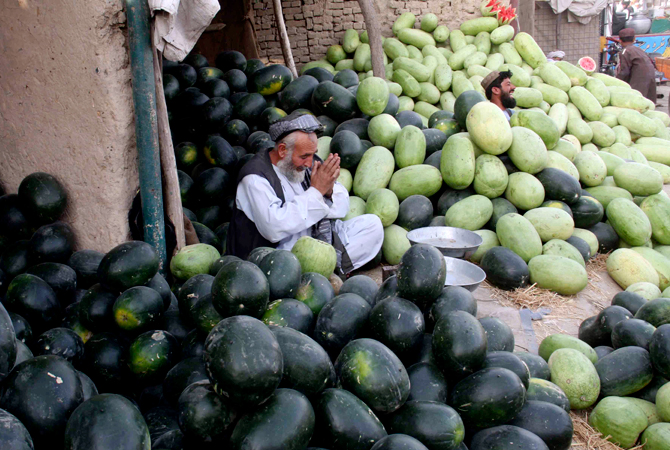
Watermelons are good too.  People here seem to go crazy for them.  Fruit-sellers in the bazaar are usually a restrained bunch, but once the watermelons arrive they walk around shouting “Watermelons!  Fresh from the field!” and even grab your arm to convince you to buy one, as one did to me this Tuesday.

How they make any money from them is a mystery to me.  Currently they’re selling for 25 rupees a kilo, which means that a decent-sized melon of 3kg can be had for 50p.  Entire trucks filled with nothing but watermelons, dark-green globules of deliciousness, cross Pakistan from top to bottom, loaded down with a commodity with a retail price of 15p a kilo.

To put that in perspective, a litre of milk (roughly 1kg) sells for 115 rupees.  A kilo of flour costs 40 rupees.  A litre of oil is probably 80 rupees.  A kilo of lentils costs 120 rupees.  Watermelons are worth less than half of the cheapest comestible I can think of.  And that final selling price of 25 rupees a kilo is the final stage of the supply line: in order to get the watermelon from the field to the bazaar involves buying seeds, watering the plants, paying someone to harvest them, paying someone else to load them onto a truck, paying the truck driver, paying for fuel for the truck, and paying someone else to unload them – and then the salesman in the bazaar will want his cut as well to make it worth his while.

So what’s my point?  Simply this: poverty is cruel.  If any of the people in the supply line were earning anything close to a living wage, enabling them to educate their kids and buy medicine and live in a decent home and eat well and save for the future, the price of watermelons – the price of everything – would be higher.  Much higher.  But since so many people in Pakistan live perilously close to the poverty line, desperate for any kind of work that will keep the wolf from the door, they can’t afford to ask for better wages.  If they did, someone else, equally desperate, would take their job.

It’s a sad realisation that poverty actually benefits me personally.

Design a site like this with WordPress.com
Get started