
Archive

Tag Archives: Pakistan

Image

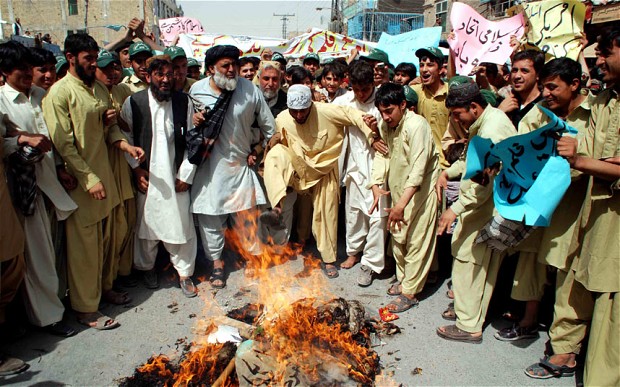
The TV screen caught my eye.  We were in a restaurant eating some delicious Pakistani food but suddenly the images of protesters waving placards and storming into embassies grabbed my attention.  Protesters in the Middle East had attacked US embassies in the Middle East in response to an amateur film which was critical of Islam and its prophet.  My first thought was whether the protests would spread further.

“Oh, don’t worry” said a passing waiter in response to my anxious question.  “People here aren’t too bothered about it”.

Well, he was wrong.  Boy, was he ever wrong.  A few days later protests exploded all over Pakistan.  Cinemas were burned, mobs roamed the streets stoning cars and attacking the police, and a large crowd attempted to storm the US embassy in Islamabad.  Our whole family stayed inside the house for four days.  Over twenty people were killed, largely in the southern megacity of Karachi.

These protests were criticised heavily, both within Pakistan and internationally.  Certainly, it is hard to see how torching a cinema and thereby destroying the livelihoods of many people is a valid way of expressing discontent.  They also seemed disproportionate to some – how could an amateur film, shoddily made in California on a tiny budget, possibly merit a response of such violence, a response which locked down Pakistan’s major cities for three days and which led to the deaths of so many people?

What people in the West largely fail to appreciate is that there is a lot of latent anger within Pakistan.  People here are angry about a whole range of issues.  Resources such as electricity, water and gas are limited.  Jobs are limited.  The population is growing rapidly and the pressure on both resources and jobs is increasing.  Prices are increasingly rapidly and salaries are not keeping pace.  Furthermore, it is widely recognised that Pakistan’s leaders are corrupt, with Transparency International claiming that $94 billion (yes, billion) have been lost due to corruption within the last four years.  People know this, and they also know that there’s not much they can do about it, and if I were in their shoes that knowledge would make me very angry indeed.

So yes, these protests were about the film, but the violent and angry response we all saw on our TV screens runs a lot deeper than that.  Lots of people here are angry and afraid.  When I caught up with a friend recently I asked him about how he saw things in Pakistan.  His response saddened me.  “Everyone here feels mental depression.  Some people can barely afford to eat.  Are you surprised that we are so angry?”.
How to eat in Pakistan

Pakistani food is fantastic.  I mean that. 

Before moving here I was mildly concerned about what we would be eating.  Once, in the UK, a Pakistani friend fed me their favourite dish, a delicacy known as “brains masala”, and the thought of subsisting on a diet of curried sheep brains filled me, perhaps understandably, with a certain amount of dread.

I needn’t have worried.  Not only is brains masala a food reserved only for special occasions, but our diet is mostly vegetarian, mostly healthy, and always delicious.  Far from becoming fat on copious quantities of curried meat I’ve actually lost weight.

Normal Pakistani food is subzi (vegetables), cooked in garlic and ginger and onions, with chilli powder added to taste.  “Aloo pullak” (potatoes and spinach), for example, or “aloo gobi” (potatoes and cauliflower), or “aloo bengan” (potatoes and aubergine), or “kudoo” (courgettes), or pretty much any permutation of vegetables that you can get from the subzi-wallahBindi (okra) is a particular favourite, as is daal (curried lentils, a South Asian staple).  When the cooking process is finished you’re left with a pan full of sloppy, slimy deliciousness, bursting with ginger, garlic, and quite possibly enough spice to strip the lining from your mouth.

 But “wait”, I hear you cry, “how is one to consume this undoubtedly delicious food without the aid of cutlery?”.

 Fear not, gentle reader, for in south Asia, as in many other parts of the world, bread serves as cutlery.  You take your roti in one hand, tear off a piece large enough to serve as a utensil, and scoop up some of the food.  Master all of these skills and you’ll never be at risk of starving to death.

Image

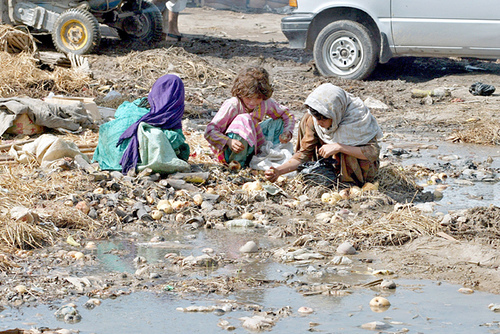
One of the challenges facing any Westerner living in Pakistan is dealing with poverty.  The difference in living conditions between us and a large chunk, even a majority, of the people we meet here presents a number of difficulties.  Of course, this is not specific to Pakistan – any person travelling from the West to any relatively impoverished country will come across poverty, such is the gulf between “the West” and “the rest” when it comes to wealth.

For me, this gulf was most starkly brought home when, early on, I was driving through our city with the kids in the back of the car.  Beggars regularly haunt traffic intersections, tapping on car windows and asking for money.  One of them, a young girl, pressed her nose up against the window where our 2 year old son was sitting.  It occurred to me that only a thin piece of glass separated them – but the gap between them in terms of wealth, life expectancy, job prospects, overall prosperity, in short every measure of quality of life – that gap was immense.  One child can expect little more than a lifetime of poverty and hardship, forced to eke out a living from the scraps of others, while the other child, possessed as he is of a Western passport, can expect a lifetime of relative comfort and entitlement.  A few millimetres of glass represented, for a few fleeting seconds, a division of heartbreaking width.

What’s a Christian to do?  This is not at all an easy question and it weighs heavily on the conscience.  While I cannot offer an easy answer, some pointers might be of use.

1. Doing nothing is not an option.  Christians are called to minister to the needs of others and in this regard we have the example of Jesus who constantly ministered to those in need.  If we simply turn our back and ignore the plight of the needy then our faith is nothing but tedious hypocrisy.  Poor people can’t eat sermons; holy words don’t put a roof over their heads.

2. Handing out money is not the answer.  This is an easy way out, enabling the wealthy to assuage their consciences by dishing out a few rupees here and there.  In doing so we effectively purchase for ourselves a few minutes of peace of mind, happy that we have done “something” for “someone”.  Well, maybe we have, and maybe we haven’t.  Those rupees may mean that a beggar eats, or they may mean that their gangmaster makes even more money for himself.  Sad, but true in many parts of the world.

3. Love and respect are worth more than money.  I try to chat to people begging from me, asking them what their name is and engaging them in conversation.  Sometimes they don’t care, eager only for money, but on a few occasions their faces have lit up as they discover that someone sees them as a precious human being rather than just an irritation.

4. Word and deed need to go together.  As I said before, mere words do not fill empty stomachs.  We try to hand out little packets of biscuits as well; at least the beggar will be able to have a little something to eat.

Ultimately it is the root causes of poverty which need to be tackled.  It is not the fact that kids beg at traffic intersections which really angers me, it is the brokenness in human institutions and societies which results in kids having to beg at traffic intersections.  Many of the beggars in our city have fled from warfare in the tribal regions; others are destitute because rich landowners throw them out or are so greedy for money that they loan money at prohibitive interest rates, resulting in entire families being forced onto the poverty line so that a rich man can build a bigger house.  This problem has to be tackled wholistically, taking the whole situation into consideration.

Martin Luther King once said that the essence of Christian love was to pick people out of ditches and set them back on their feet – and, eventually, to tackle the injustices which result in people being throw in the ditch.  We need to do both.  It’s a big job, but thankfully we have a big God, too.

Image

One night in June I started to feel pain in my stomach.  This is common around here, what with the tap water containing more bacteria than a microbiologist’s petri dish, so I thought little of it.  When the pain got worse, and then even worse, I started to wonder if I should do something about it.  And when it became unbearably painful I asked a friend to drive me to a hospital in the mountains, some three hours away.  That journey, over bumpy mountain roads in the middle of the night with me vomiting into a bucket every fifteen minutes, is a story in its own right.

                 To cut a long story short it ended up being a very serious problem indeed which required some particularly invasive and unpleasant surgery on my intestines.  This required a two-month period of convalescence in the UK, as it was 45 degrees in our home city in Pakistan, a temperature not exactly conducive to recovery from a major illness.  We flew home and spent two months resting, eating good food, visiting family and friends, and trying to persuade people that we couldn’t wait to return to Pakistan again.

And now we’re back.  It’s great to be home.  Normal service, whatever that means, will shortly resume on this blog…

Pakistani food is fantastic.  I mean that.

Before moving here I was mildly concerned about what we would be eating.  Once, in the UK, a Pakistani friend fed me their favourite dish, a delicacy known as “brains masala”, and the thought of subsisting on a diet of curried sheep brains filled me, perhaps understandably, with a certain amount of dread.

I needn’t have worried.  Not only is brains masala a food reserved only for special occasions, but our diet is mostly vegetarian, mostly healthy, and always delicious.  Far from becoming fat on copious quantities of curried meat I’ve actually lost weight.

Normal Pakistani food is subzi (vegetables), cooked in garlic and ginger and onions, with chilli powder added to taste.  “Aloo pullak” (potatoes and spinach), for example, or “aloo gobi” (potatoes and cauliflower), or “aloo bengan” (potatoes and aubergine), or “kudoo” (courgettes), or pretty much any permutation of vegetables that you can get from the subzi-wallahBindi (okra) is a particular favourite, as is daal (curried lentils, a South Asian staple).  When the cooking process is finished you’re left with a pan full of sloppy, slimy deliciousness, bursting with ginger, garlic, and quite possibly enough spice to strip the lining from your mouth.

But “wait”, I hear you cry, “how is one to consume this undoubtedly delicious food without the aid of cutlery?”.

Fear not, gentle reader, for in south Asia, as in many other parts of the world, bread serves as cutlery.  You take your roti in one hand, tear off a piece large enough to serve as a utensil, and scoop up some of the food.  Master all of these skills and you’ll never be at risk of starving to death.

Design a site like this with WordPress.com
Get started