Archive

Tag Archives: Pakistan

One thing you will rapidly notice after coming to Pakistan from the West is that power cuts are a fact of life here.  Back home in the UK power cuts happen very occasionally, perhaps two or three times a year, and usually for not more than a few seconds.  Once the power went for half an hour and people on our street were so startled that they went out into the road to see what the problem was.  We spent more time with our neighbours on that single day than we would normally in a whole year, which, when I come to think of it, is rather sad.

 But I digress.  I’m writing about power cuts, not the lack of a concept of community in modern Western culture.

 In our city in Pakistan the electricity goes out several times a day, and when it goes out it stays out for an hour or more.  In an average day we have power cuts between 6am and 7am, 9am and 10am, 12pm and 1pm, 3pm and 4pm, 6pm and 7pm, and between 9pm and 10pm.  That’s a total of 6 hours of the day – and those are just the waking hours; power cuts also happen at night.

 And that’s just a normal day.  Occasionally, when there are major roadworks in the neighbourhood or when a transformer blows, the power can be cut for several hours at a time.  The longest cut we ever experienced was when the transformer on our street exploded with a blinding flash: we were without electricity for a full 12 hours.

 I don’t know what the reasons are for Pakistan’s epic electricity shortage, other than what I read in the Economist and elsewhere, which is that some rather important people don’t pay their electricity bills.  This is pretty tragic because, domestic inconvenience aside, power cuts play havoc with Pakistani industry.  Can you imagine running a factory profitably when your machines will only be able to function for two-thirds of the day?

 For us this is an inconvenience which can mostly be avoided by adjusting our schedule and by installing a UPS – essentially two car batteries connected to a small box which flicks over when the power goes, enabling us to run a few crucial appliances (lights and fans) on battery power.  Not a big deal, although it does make us envious of how easy life is in Western countries.  The things we take for granted, eh?
Recently I went to the bank to be added as a signatory to a bank account.  This seemed like a reasonably straightforward transaction, especially as the bank was more or less empty at the time.  Name…check.  Signature…check.  Passport number…fine.  Witnesses…oh.

Two people had to sign their names as witnesses of the transaction, said the helpful bank employee, a smartly dressed young lady.  Can you do it yourself, we asked?

“No, sadly not.  For two reasons.  Firstly, because I am a bank employee”.

Oh, that’s fair enough.  Probably some kind of anti-corruption measure, which is sensible.  And the second reason?

She coughed quietly and looked straight at me.

“Because I am a woman”.

Image

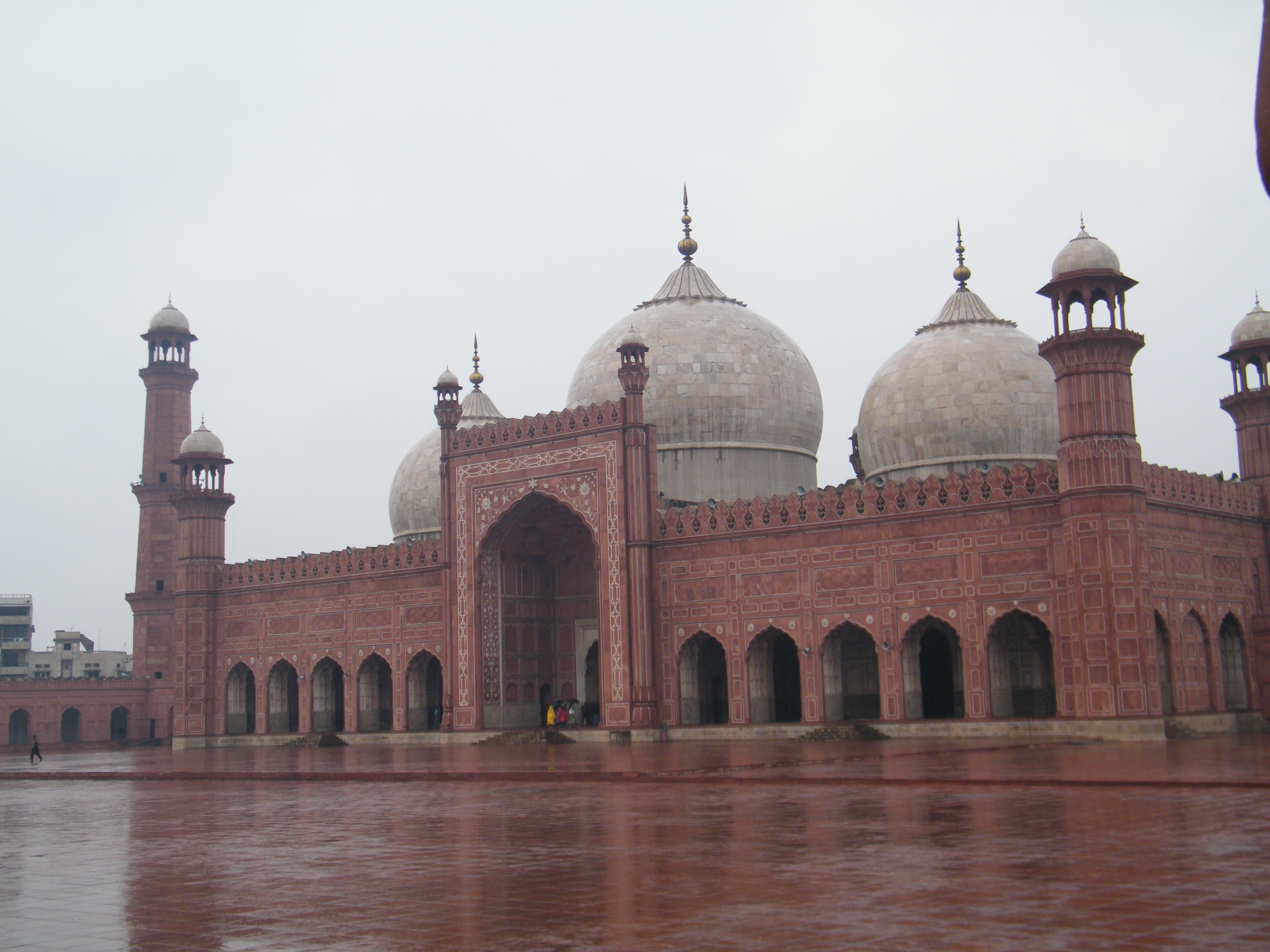
Here’s a confession: I have been to Lahore a total of five times and only recently, on my fifth trip there, did I get round to visiting the Badshahi Mosque.  This is strange, seeing as it is one of the premier historical attractions of Pakistan and I am keenly interested in history.

Never mind, though – despite my tardiness I eventually got around to visiting it, and I wasn’t disappointed.  Its size alone makes it stand out – it is vast, with a courtyard large enough to accommodate some 95,000 worshippers.  It was the largest mosque in the world for over 300 years, until it was overtaken by the Faisal Mosque in Islamabad.

I don’t want to add much more – if you want to learn about it, head over to Wikipedia in the first instance – but I can confirm that it is large, beautiful, a remarkable piece of Moghul engineering, and that we were welcomed warmly when we visited.  Hopefully the above photo will speak for itself…

It gives me no pleasure to write negatively about Pakistan.  Far too many people do that already.  Scan the airwaves for articles about Pakistan and the overwhelming majority will be negative.  In fact I can predict with some confidence the kind of phrases you are almost guaranteed to read: failed state, nuclear weapons, terrorism, sectarian conflict, human rights abuses.  What bothers me is not that these things are untrue – there is some truth in them, at least – but that they represent only one side of Pakistan.

Yet despite my fondness for the country I have come to call home I cannot deny that inequality is one of the most visible aspects of life here.  In Pakistan I have visited the homes of the wealthy, with air conditioning in every room, paintings on the walls, crystal glasses, fine china, and luxury food three times a day.  I have also visited the homes of the poor, mere shacks of battered brick propped up with planks of wood, where dinner is cooked over a cow-dung fire.  And I have seen homes even more impoverished than that: the shacks of canvas and cardboard which shelter the masses of shivering refugees from Afghanistan, Baluchistan, the tribal areas.

In Pakistan luxurious Toyota trucks with sparkling paint drive past children begging for rupees at traffic intersections.  The homeless sleep on pavements, huddled in thin blankets, while the children of the wealthy walk past to their expensive schools, dressed in crisply-ironed uniforms.  The wealthy splash thousands of rupees on dinner at one of the seven restaurants in the Islamabad Marriott while outside the homeless eke out an existence on the grace of others.

A friend who works in northern Pakistan commented that when he takes his household trash to the dump he is followed by gangs of children who fight over what his family throws away.  Once, in Murree, I was so moved by the street kids who followed me around begging for food that I handed over the can of Coke I was about to drink – only to see them fight for it viciously.

Inequality exists everywhere; we live in a world in which billions of dollars is spent on dog food in the West while children starve to death in Bangladesh and Mongolia.  But it feels more stark in the developing world.  Perhaps welfare softens the starkness of inequality in the West, while the absence of state welfare over here means that the poor really are wretchedly poor.

What’s a Christian to do?  We can’t ignore it.  We can’t do nothing.  But the task seems too great for any personal effort to make a tangible difference.  “Be the change that you want to see in the world” said a famous South Asian, Mahatma Gandhi – not a bad place to start, I suppose.

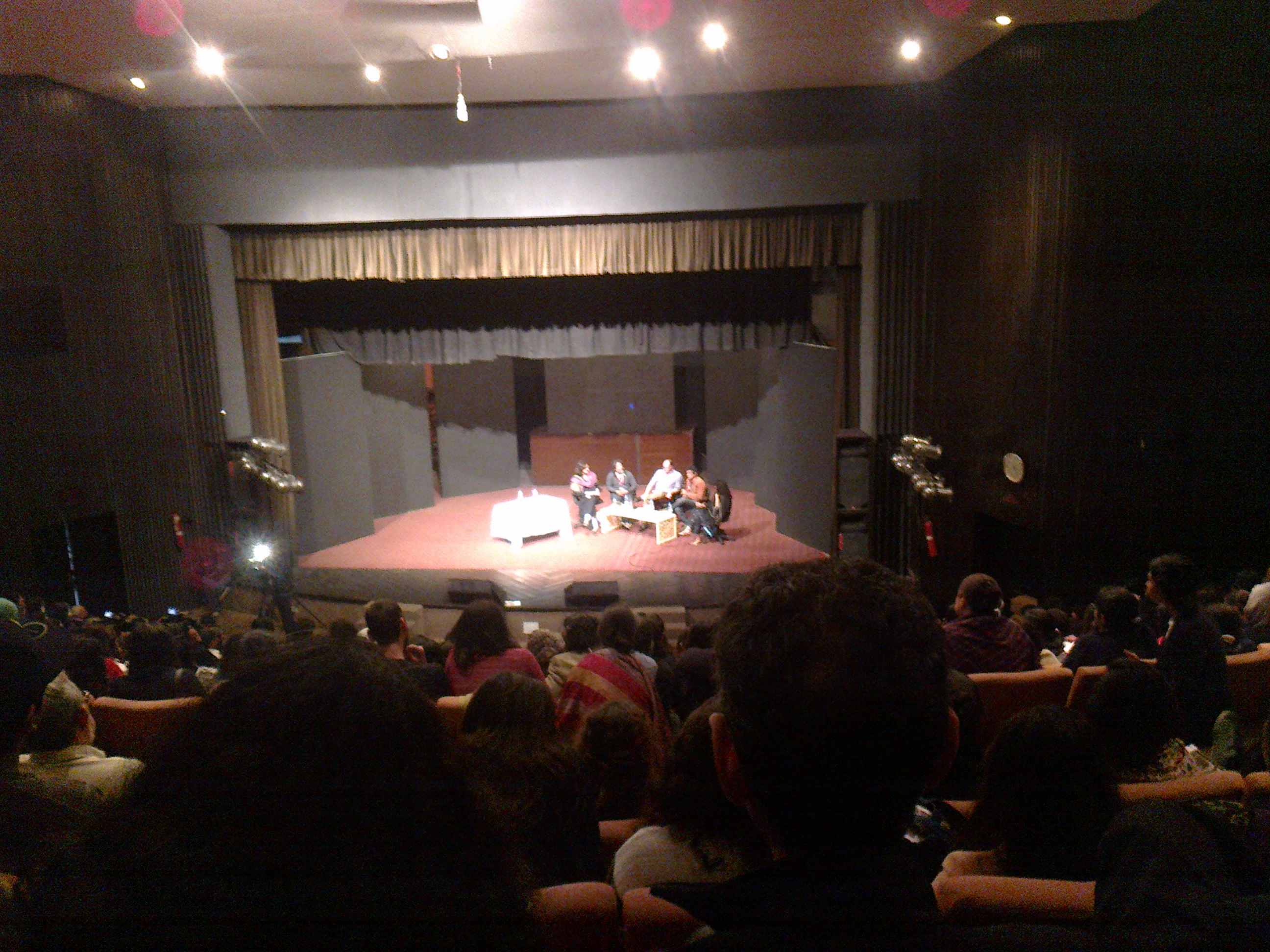
We were talking to a friend the other week who works down in the Punjab.  Among other things, he casually mentioned that there was going to be a Literary Festival in Lahore in a couple of weeks.

 “Oh” he added.  “And William Dalrymple is going to be there”.

 That was it, we were going.  For my wife and me, people who are interested in Asia, Christianity, travelling and history, hearing William Dalrymple speak is about as exciting as things get.  His book From the Holy Mountain is just about my favourite book ever, and his other ones are excellent too – In Xanadu, City of Djinns, and his history book The Last Moghul is one of the best I’ve ever read.  And as if that wasn’t enough, excellent Pakistani authors were going to be there too – Mohammed Hanif, Mohsin Hamid, Bapsi Sidhwa, for example.

 If you haven’t heard of those three authors, you need to.  Get thee to Amazon, gentle reader, and start buying!

 Well, it was excellent.  Well organised, with interesting topics, and the turnout was incredible – hundreds and hundreds of enthusiastic young bibliophiles (that’s Latin for “book nerds”) packing the auditorium and applauding their literary heroes enthusiastically.  Some sessions were so popular that they had to shut the doors to stop people crowding in.

Image

And that, I think, is the abiding memory I’ll take from it.  Living in Pakistan we see one side of life very frequently – the poor, dusty, messy side, with beggars at traffic intersections and trash in the streets.  What we don’t often get a chance to see is what we saw at the Lahore Literary Festival – the huge number of Pakistanis who are intelligent, well-informed, passionate about their country and eager to make it better.  They were full of questions, asking Mohammed Hanif about the role of satire in modern Pakistani literature, applauding Ahmed Rashid when he criticised the Pakistani government, listening attentively to recitals of Urdu and Punjabi poetry.  What a country could be built by people like these!

 The silent majority of Pakistanis are informed, educated, and take an interest in world affairs.  This was the first time that I’ve seen them make their voice heard.  Long may it continue.

 Oh, and William Dalrymple wasn’t bad, either.

 Hold on tight, here comes a comment which is Completely Blindingly Obvious: Pakistan is a very religious country.

Image

 Not much of a surprise, is it?  Pakistan was the first Islamic state ever founded, carved out of British India by the iron will of Mohammed Ali Jinnah and set up as a homeland for the Muslims of the subcontinent.  Muslims from across India moved here, fearing for their future in a Hindu-majority country, while Hindus and Sikhs living in what was about to become Pakistan flooded the other way.  Right from the outset Pakistan’s identity was defined by the religious persuasion of the overwhelming majority of its inhabitants.

 And this religious identity runs even deeper than that.  Pakistan is a pretty loose-knit country, consisting of a range of ethnicities with not a whole lot in common: Punjabis, Pakhtuns, Baluchis, Sindhis, Kashmiris, people from the Northern Areas, and then a whole new group of Mohajirs – refugees who fled here from India and made a new life for themselves.  In my experience these groups have only a few things in common: hospitality, the ability to cook amazingly good food, a distrust of India, and Islam.  And even the Hindu and Christian minorities, about whom I will write in greater length another time, are deeply religious.  Early on in our time here I tried to explain to someone that modern Britain is a mostly secular country – but trying to translate “atheist” into Urdu proved tricky; nobody really knew how to say it, so we ended up by using the word “pagan” which is not really the same.

 See?  Pakistan is a country which has no comprehension of the word “atheist”.  It’s probably like trying to explain to a man living in the Gobi desert what snow is like.

 This identity affects more or less every sphere of Pakistani life.  The daily routine is punctuated by the call to prayer which echoes out at defined intervals.  Friday, the holiest day, sees most shops shut.  If you ask someone how they are they will probably respond “thanks to God, I am well”.  Everything has religious names – shops might be called “Bismillah Drinks Stall” (Bismillah means In the Name of God) or “Praise God Chicken Shop”.  I once bought some house plants from a guy in the bazaar who prefaced every single comment he made with the phrase “Insha’allah”, which made for a slightly odd conversation:

 Me: How much is that one?

Salesman: God willing, it is two hundred rupees.

Me: And that other one?

Salesman: God willing, it is only one hundred and fifty.

Me: Ok, I’ll have that one and that one.

Salesman: God willing, that is ok.

Me: How much does it come to?

Salesman: God willing, three hundred and fifty rupees.  But, God willing, as you are a guest, I will make it three hundred.

 And so on.

 There are two points I particularly want to make.  Firstly, the vast majority of Muslims I meet here are charming and polite in the way they present their religion.  Of course, there are different faces of Islam in Pakistan – there are groups who will murder Shi’a people because their interpretation of Islam differs from their own, for example – but every Muslim I have met has been polite, interested, and sincere.  I’m a Christian, so they disagree with me, but they do so nicely.

 And the second point is this: I like the religiosity of Pakistan.  I like that religion is a big deal here, because it’s a big deal with me.  I like the fact that I can walk into the bazaar and have a conversation about religion with just about any stranger I meet.  Modern Britain is so aggressively secular that any mention of religion marks you out as some kind of weirdo; received wisdom is that religion is dangerous, warlike and retrograde.  Over here, by contrast, everyone talks about religion, among most Pakistanis there is an ingrained respect for faith, and generally it is peaceable.

 There are exceptions, of course.  I’ll write about those later.  But the broad picture is probably a lot more pleasant than you’d think from reading the Western media.  As a Christian I much prefer a country which writes “Praise God” on its buses to one which writes “There is probably no God, so stop worrying”…

Image

People make generalisations about Pakistan all the time.  I don’t like it when they do, because they tend to be negative – “it’s dangerous”, “Pakistani people hate the West”, “it’s a failed state”.  But here I am making another one: Pakistan is a remarkably hospitable country.

It really is.  I used to post updates on Facebook of all the times people treated me differently because I was a guest: taxi drivers who refused to take my money, vegetable sellers who were so charmed by my stuttering Urdu that they gave me free tomatoes, shop-keepers who invited me to drink tea with them after an acquaintance of, oh, two minutes.  After a while I stopped because there were just too many stories, and people were getting bored of them.

Perhaps in stopping these updates I did a great disservice to the people of Pakistan because hospitality is the salient characteristic of the people here, by a long way.  When you watch the news you may get the impression that people here are angry and hostile.  When I walk through the bazaar, on the other hand, my impression has been unremittingly positive.  People here are instinctively and unfailingly polite, charming, helpful, and welcoming.

I have so many anecdotes I hardly know where to start.  A week ago I went to a different bazaar to buy vegetables and had to insist four times before the stall-holder would accept my money.  A taxi-driver a month or two earlier was slightly easier; I only had to insist three times.  Once I was driving with a friend when his car broke down.  Two passers-by dashed over to help us push it to a nearby gas station to get it fixed and steadfastly refused payment afterwards.  Buying bread from a tandoor (clay oven) a while back was tricky in that the roti-wallah refused payment on the grounds that we had been away from Pakistan for a month and he wanted to welcome us back.  Another time, on a trip to a city in the Punjab, some desperately poor people invited us into their home and insisted that we drink Pepsi, even though the price of a single bottle could have fed their family for a day.

I can’t promise that this hospitality is innate among every single person in Pakistan; I imagine there are some who are so hostile to the West that, were they to meet me, hospitality would be the last thing on their minds.  What I can say is that after two years and several hundred personal meetings with Pakistani people every single one has been polite and hospitable.

Here’s a final thought.  If a Pakistani were to travel to the UK, or Canada, or the USA, or somewhere else in the West, and met two hundred or so individuals, would every single one be hospitable and polite to them?  How about you – if you met a Pakistani on the streets of London or Toronto wearing shalwar kameez and a prayer cap, what would your initial thoughts be?

Next time, why not try being polite?  Saying “salaam aleikum” and smiling goes a long way, you know.  It might be the most Pakistani thing you do all day…

One of the consequences of living in a newsworthy country like Pakistan is that people always want to know what it’s really like.  The media is at least partly responsible for this interest: people see images of bomb attacks, drone attacks, protests and other events in Pakistan, then remember that they have a friend living in that same country, and immediately want to know how things seem from our perspective.

 Answering this question takes more time than they usually want to spare for the simple reason that Pakistan is a complex country.  Everyday life defies simple explanations, which is what people usually want.  Contrasts exist in Pakistan like nowhere else I’ve experienced.  I’ve seen camels strolling casually down a major city street, side by side with brand-new Land Cruisers and Corollas.  I’ve seen brand-new frozen yoghurt shops that seem to have come straight from California – and penniless Afghan orphans sitting outside, sifting through rubbish to earn a crust of bread.  In major cities here you can eat imported American cheeseburgers alongside Pakistanis wearing designer clothing and taking pictures of each other on iPhones, and then walk outside to see homeless casual labourers dressed in rags waiting for work.

The simple answer is that there are lots of different Pakistans.  A very religious Pakistan, and a largely secular Pakistan.  A rich Pakistan and a poor Pakistan.  A safe Pakistan and a dangerous Pakistan.  A Pakistan of startling beauty and a shockingly ugly Pakistan.

So, in an attempt to answer this question, I’ll write a series of blogs about this wonderful, perplexing, bizarre country, in an attempt to provide a more rounded and realistic impression of Pakistan than one tends to get from the news outlets.  Stay tuned!

We’re moving house.  In winter the gas supply on our street drops to almost nothing, meaning that last year we had three months of cold showers, cold food and constant shivering.  You wouldn’t think that being cold would be a problem in Pakistan, given the searing summer temperatures, but the lack of central heating and carpets, together with the surprisingly chilly winters, means that winter can be unpleasant too.

 One of the benefits of moving is that it enables us to paint the house however we like.  Pakistani landlords are wonderfully open to repainting, certainly compared to British ones, so the entire palette of paint colours is open to us to do as we like.

 And what marvellously daft names they have!  Acapulco Blue.  Cashmere Beige.  Antelope, Coriander, Pumice.  Wild Orchid.  Champagne – funny, that, in a dry country.  My mind boggles at the thought that someone, somewhere, is paid money to think up this kind of euphemistic nonsense.  Some poor sap is sitting in an office somewhere, desperately trying to think up new and exotic ways to describe the colour “red”.  So if you think your job is dull and unedifying, spare a thought for that guy.

 Anyway, the paint catalogues made me think about creating a palette of colours to describe some of the things we see in everyday life here in Pakistan.  So, without further ado:

Rickshaw Blue: the pale, blue-grey colour of the smoke clouds that rickshaws belch out as they clatter around the place.

Revolting Brown: the colour of the water after I wash my hands in it after a day in the bazaar.

Murree Green: the deep, lush, verdant green of the mountains of northern Pakistan in early summer.

Bougainvillea Purple: the vivid purple of the exuberant mounds of flowers which spill out of gardens all over Pakistan.

Kaghan White: the colour of the snow which clings to Pakistani mountains well into the summer.  Basically just white, but, you know, you’ve gotta make it sound fancy.

Loadshedding Black: just black.  Like when the electricity dies and all the lights go out.  For the fifth time that day.

 There must be more, but for now I need to go and choose some paint colours…

The film protests seemed to make people around the world think that Pakistanis are inherently angry people.  Such a small issue, they said, and such a disproportionate response!  The days of rioting seemed to confirm their suspicions that the population of Pakistan consisted of mainly angry people and religious fundamentalists, many of whom were also pretty angry.

I disagree.  The thing which strikes me most about Pakistani people is how hospitable and friendly they are.  I was struck by this when I arrived here and it continues to have an impact on me, more or less every day: when shopkeepers offer to buy me drinks and chat, when taxi-drivers and samosa-sellers try to refuse my money, when just about every man I meet in the bazaar engages me in polite and interested conversation.

Image

The amazing thing about this is that Pakistanis have every reason to dislike and distrust foreigners.  The land which is now Pakistan has been invaded by just about every military conqueror that history has to show: Alexander the Great, the early armies of Islam, the Afghans, the Persians, the Moghuls, and finally my ancestors, the British.  And even after that, when Pakistan was founded and people finally achieved their independence, the influence of world powers flowed across this land: the long proxy way against the Russians in Afghanistan and then the Americans, with their counter-terrorist operations and their drone strikes.

Think about it: if your country had lived through all of that, wouldn’t you be suspicious of outsiders?  And if those same outsiders were still bombing targets within your country, free from any restraint imposed by international law, mightn’t you be a bit angry?

But no, Pakistanis are invariably polite, welcoming and hospitable, despite the fact that foreigners have been meddling in their affairs for about two thousand years.  Angry Pakistan?  Painfully Polite Pakistan, more like.

Design a site like this with WordPress.com
Get started