
Archive

Pakistan

We had a Christmas carol party at our house the other day: thirty foreigners from six or seven different countries all gathered together to sing carols, eat cookies, and drink coffee.  Unsurprisingly, it was a lot of fun.  Perhaps surprisingly, it brought the meaning of Christmas home in a very stark way.

Christmas carols are usually associated with fun and jollity – the kind of thing Westerners listen to as they do their Christmas shopping.  Since Christmas, at least in the West, has become a hyper-commercialised orgy of consumption and unnecessary expenditure, stripped of its Christian origins, so Christmas carols have become part of the cultural backdrop of the West – and so “Away in a Manger” is mashed up with “Jingle Bells” and “Driving Home for Christmas” and Mariah Carey singing “All I Want for Christmas Is You”, and may God have mercy on us all for that particular crime against humanity.

Singing these carols in Pakistan, where Christmas passes largely unnoticed, stripped of all of its commercial baggage, brings the meaning of Christmas home to us in a very striking way.

Put simply: Christmas carols are dark.

Take this, from “We Three Kings”:

“Myrrh is mine, its bitter perfume / Breathes a life of gathering gloom / Sorrowing, sighing, bleeding, dying / Sealed in a stone-cold tomb”.

Or this, from “O Come, O Come Emmanuel”:

“Oh come, thou Rod of Jesse, free / Thine own from Satan’s tyranny / From depths of hell thy people save/ And give them victory o’er the grave”.

Not exactly chirpy, is it?  Or this, from “Oh Holy Night”:

“Long lay the world in sin and error pining / Till he appeared and the Spirit felt its worth / A thrill of hope the weary world rejoices…”.

The point is this: in wrapping Christmas in a bundle of gaudy, tinselly baggage of consumption and self-interest we have missed its most important point: that the birth of Jesus was part of a rescue mission to save a dark and broken world from its own slow suicide.  It is a time of rejoicing, yes – but only in that we are celebrating the arrival of the Messiah who came to save us.

It is ironic that I spent most of my life in a “Christian” country and yet only really appreciated the true beauty and power of the Christmas story when living in a Muslim country.

Recently we travelled to another city in Pakistan and returned to our home late in the evening.  While we were unpacking and getting the kids ready for bed there was a knock at the door.  My wife opened it to find our landlord’s wife standing there with a tray of food – rice, kebabs, and sweet custard – in her hands.  She bowed, handed it over, and quietly left.  We never asked for it – she just knew that we had been travelling, had not had any time to make food, and were therefore in need.  This kind of instinctive, unassuming hospitality is entirely typical of Pakistani people.

The thing is, handing back an empty plate is considered rude in this culture (as it is in other Muslim cultures, I believe).  So once we had eaten the kebabs and rice (which were predictably delicious) and washed the plate, my wife put some chocolate brownies on it and sent it back down.

Unwittingly, we had started a game of hospitality tennis.  Our landlord’s wife felt obliged to send food back up – rice and lentil curry – so my wife returned the plate with a cake on it.  Pizza came up next, wrapped in clingfilm, and home-made cookies went back down again.  Hospitality was bouncing back and forth like a tennis ball at Wimbledon.  One day our landlord’s son got his exam results so my wife baked him a cake and sent it down, along with another plate of brownies – the hospitality equivalent of an overhead smash – and we thought that was the end of it…

…that is, until rice, chicken wings and salad came back up the stairs again, followed by a plate of samosas.

I don’t know when this match of hospitality will be over, but this I do know: I’m getting fat.

Pakistan Daily Life

The taxi rattled over the rutted road.  It lurched and lunged, bouncing from side to side, creaking as if it were on the point of falling apart completely.  It was a beautiful autumn day in Islamabad with a bright sun and a mild chill in the air.  In the nicer parts of the city trees were starting to change colour, their leaves fading to red and yellow, but this was not a nice part of the city.  We were driving down a road which passes one of the largest slums in Islamabad, a place of mud huts and ramshackle roofs and filth-rimmed ditches and unemployment and hopelessness.  As we rattled down the road I looked out at the slum with despair in my heart

Scenes caught my eye as they flicked past, tiny snapshots of life lived at the fringe of society.  An elderly man was hauling a cow through the streets, tugging and shouting as the obstinate animal dug in its heels.  A younger man, perhaps my own age, was pushing a wooden trolley piled high with bananas.  Two boys were using sticks to roll bicycle tyres along the side of the road.  Tiny girls, surely not more than three or four years old, carried plastic bags stuffed with something indistinguishable, stumbling along as their tiny sandals flipped and flopped in the dust.  Another girl, maybe six or seven, sat by the side of the road, twirling her hair absent-mindedly as the cars clattered past.  The gesture reminded me of my own daughter – but I am wealthy, and so my daughter goes to school, and eats three meals a day, and sleeps in a house, and has the unimaginable luxury of being able to choose what she wants to wear on a particular day, and the inequality of this situation makes me feel like weeping.

The taxi driver saw me staring at the slum and tried to explain.  This was government land, so the people here are squatting illegally.  At some point the government will come through and clear them out, and they know this, and so they do not bother building proper houses.  They will be forced to leave, and they will find somewhere else to live, and will rebuild their pathetic dwellings of sticks and mouldy canvas, and when it rains they will get sick, and many of their children will die young, and they accept all of this with resignation.

“Their life is so difficult” said the driver.  “There is no purpose to their existence.  They may as well not have been born”.  He spoke not with malice but with sympathy.

The phrase stuck in my mind.  As a Christian I firmly believe that life has a purpose, that we were created with love and for a reason, and that every human being is precious and individual and worth something.  And yet here in this slum, and in countless millions of other slums that dot the developing world like cancer cells, life literally has no purpose.  It is a matter of scratching together enough food for the day and hoping to do the same tomorrow.  They cannot afford school fees so their children will never study and learn and so will remain poor, and thus poverty is propagated and institutionalised and the rich gift of existence is reduced to penury and wretchedness.

As we drove away the slum receded into the rear-view mirror. Soon it was gone from sight – and yet it lingers in my mind, dark and hopeless, and I do not know what to do to help.

Imagine that one of your neighbours had a disagrement with another neighbour.  Imagine, say, that the neighbour on one side of your house had a disagreement with the neighbour on the other side.  Now imagine that they decided to settle the dispute by fighting.  Further imagine that they decided to fight it out in your back garden, even though you had nothing to do with the original dispute.

Congratulations: now you know how Pakistanis feel.

It has long been the fate of this corner of the world to become the battleground for wars that do not immediately concern it.  Pakistan has played host to more proxy conflicts than one would expect.

Think about it.  Alexander the Great breezed through here, his army passing a few kilometres north of where I am currently typing, on his way east.  The Mongol Emperor Timur came down from Central Asia, crossed the Indus in what is now Pakistan, and went on to capture Delhi.  The Persian Emperor Nadir Shah came through on his way to sack Delhi a few centuries later.

The British later arrived, trekking through from west to east in their ill-fated invasion of Afghanistan in 1839.  Pakistan then became the location of the Great Game as Britain and Russia fought out their differences in the late 19th century.  Then came 1989 and the war in Afghanistan, with Pakistan becoming a place for refugees, for arms storage, and training.  These days we see drone strikes and an increasing sense that the rivalry between the Saudis and the Iranians is being fought out in Baluchistan and, ideologically, the madrassas of Pakistan.

Perhaps the main problem is Pakistan’s conveniently strategic location, on the main route between East and West.  That is only going to increase as China invests in Pakistan in order to circumvent India and as foreign troops leave Afghanistan.  It is deeply unfair that the problems of the world are dumped in the lap of the Pakistanis and even more remarkable that they are still so welcoming to foreigners, considering what they’ve been through…

In 1947 British India was divided into two countries, India and Pakistan.  Their lives as independent nations began at the same time, and yet since then the two countries have diverged drastically.

Modern India is a stable democracy with a growing economy.  Pakistan only just completed its first democratic transition of power, is burdened with serious security issues, and has a lacklustre growth rate.

India is a significant target for investment from the West and elsewhere in Asia.  Potential investors in Pakistan are put off by its predictable unpredictability and its chronic power shortages.

India just sent a space probe to Mars.  Pakistan is not yet able to provide more than half its citizens with an education.

This assessment is not entirely fair – things in India are not quite as rosy as Western filmmakers would have you think, with corruption, economic problems and a cruel caste system that often results in violence against women, while conversely Pakistan is really not as bad as the Western media makes out – but it is undeniable that, broadly speaking, the two countries have travelled along different and diverging paths since the summer of 1947.

The question is this: why?

Some people blame Islam, but this surely cannot be fair.  Malaysia is a predominantly Muslim country and yet is relatively prosperous, while Nepal, a Hindu majority country like India, is wretchedly poor.  Corruption is also notoriously high in Christian countries like Nigeria and Kenya.

Some people blame the army.  The amount of money spent on the Pakistani army is dizzyingly high – some 30% of GDP – but the army is more or less the only trusted institution in Pakistan and has saved Pakistan from domestic chaos on a number of occasions.

My best estimation would be that a number of factors are at play, including a lack of education, a culture of endemic corruption, the physical makeup of Pakistan (a couple of prosperous and fertile provinces, coupled with wild mountains and remote deserts that are chronically undeveloped and miserably poor), and a cruelly unjust social system in which the poor are kept in poverty by the avarice of the wealthy.

It simultaneously baffles and saddens me that a country with such potential can be so horribly misused.  The Pakistan Paradox is a rich and dark mystery for Pakistan’s leadership, and global institutions, to resolve at their earliest convenience…

Our son woke us at 4am.  He was obviously distressed, coughing and gasping, clutching at his throat.  Despite this he was quite calm as he informed us, in a matter-of-fact manner, that he had a coin stuck in his throat.

Bad dream?  No.  He was insistent, and clearly awake.  He had thought that the cool metal would soothe the sore throat from which he had been suffering for a couple of days.  I bundled him into the car and took off for the hospital.

Contrary to what you might expect, excellent medical care is widely available in Pakistan.  Many hospitals here offer superb services and are staffed by Western-trained professionals.  We were attended to quickly and courteously.  Once they had ascertained that the coin was lodged in the oesophagus and not the trachea – in other words, that my son was not about to suffocate to death – we were sent to the front desk to register.

I walked up to the desk and signed the requisite forms.  The man behind the desk glanced up at me with the kind of bleary-eyed brusqueness that one tends to get from hospital clerks who are forced to work at 4am.

“50,000 rupees” he snapped, before glancing back at his computer.  In Pakistan you pay for medical treatment before you receive it.

I had come prepared.  With one swipe of my credit card the bill was paid.  I signed the receipt and was about to walk off when I heard the person behind me exclaim, in panic:

“50,000 rupees?  I don’t have that kind of money!”.

It was an middle-aged man, accompanied by his wife and their child, a girl with vomit all down the front of her sweater.  The clerk yawned and pointed to a sign above his desk which read “Advance Payment Required Before Treatment Offered”.  He shrugged.

The man sighed, turned round, and headed for the exit.  He walked out into the night, followed by his wife and daughter.  I turned back, my receipt safely in my hand, and walked back to my son.

CNG-STATION-queue

The taxi creaked as it rattled over the rutted road.  The driver looked sideways at me and smiled appreciately.

“You look good in that shalwar kameez.  You’re practically Pakistani!”.

“ I like Pakistan” I replied.  “It is a wonderful country in many ways”.

He sighed.

“Everything here is corrupt.  This country has everything: coal, gas, oil, fruit, wheat, and yet people are hungry and poor.  This country will never get better”.

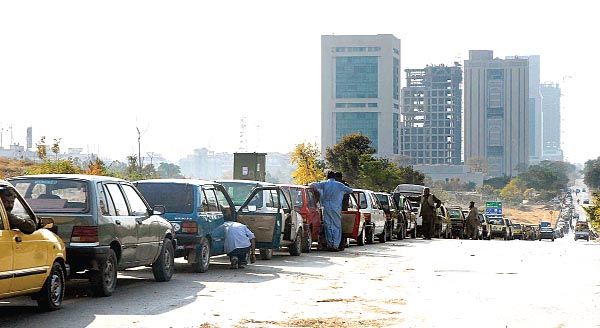
We drove past a CNG filling station.  Compressed Natural Gas is the fuel of choice for Pakistani taxi drivers simply because it is cheap, yet because of shortages it is only available for two days a week.

“Look at that line of cars!” he said as we drove past a queue of battered taxis several hundred metres long.  “They’ll be waiting for five, maybe six hours just to get enough gas for the day’s work.  Most of them probably got up at 4am to start queueing.  They are poor, and their children will be poor, and their children’s children will be poor, and nothing will change”.

I sat in silence.  The taxi swerved around a pothole, then swerved back again to avoid another.  The road was corrugated and cracked like the cover of an antique book.

“And look at the roads!  Nobody fixes them, and this is not some tiny village, this is one of the biggest cities in Pakistan.  Even village roads in your country are probably better than these”.

I didn’t say anything.  He was right; they are.  His voice was not angry or bitter.  It was worse than that: it was numb, as though despondency had anaesthetised his ability to care.

Struggling to make him think more positively, I asked what he thought should be done to improve things in Pakistan.  He sat quietly for what felt like an age, then said:

“I don’t know”.

I bumped into an old acquaintance the other day.  He’s a guy from the tribal areas of Pakistan who drives a taxi for a living.  Like most Pakistani taxis, his is old, clunky, slow, and seemingly held together by little more than duct tape and force of habit.  Like most Pakistani taxi drivers, he overcomes these shortcomings with a solid sense of humour, a total disregard for safety, and a lot of prayer.  Every time he starts the engine, turns a corner or changes a gear he says the simple prayer “Bismillah” (“in the name of God”).  I’m not quite sure if this habit is charming or worrying.

Anyway, I asked him how he was, how his family was, and how he spent Eid.  For once his customarily cheerful face fell.  He shrugged his shoulders.

“I’m a poor man.  I couldn’t afford to sacrifice an animal.  What kind of Eid is there for someone like me?”.

I spent two years studying Urdu.  It was by turns tiring, fascinating, and tedious, but the result of those two years of study is that I can converse with more or less anyone across Pakistan about more or less any topic that comes up.  It was worthwhile, and I would recommend it to anyone.

Yet modern Urdu is a flexible beast and has taken on a great deal of English vocabulary.  Many Pakistanis will, in the course of conversation, flick English words into the mix – even words they don’t actually understand themselves: “actually”, “safety point of view”, “sincere”.  Some even flick back and forth between English and Urdu at dizzying speed, one sentence in each language, like some linguistic version of alternating current.

The other day I was trying to explain to our electrician that I wanted to install mosquito lights in our new house.  I took a deep breath and explained, in flawless Urdu:

“You see, dear brother, they are lights which are attached to the ceiling and which give out a strange sort of blue light.  When mosquitoes and other flying insects see this light they are attracted to it, and when they fly into the light they are killed, and our home is protected so that my children can sleep soundly at night.  Tell me, what are they called?”.

He thought for a moment and nodded.

“Ah yes” he said in Urdu, and then, in English:

“Mosquito lights”.

Why did I bother?

Eid ul-Azha is one of the major Islamic festivals, roughly equivalent to Christmas in its significance.  It commemorates the willingness of Abraham to sacrifice his son Ishmael and the provision, by God, of a ram in his place.  This is strikingly similar to the Christian version in Genesis 22, the only difference being that Christians celebrate Isaac instead of Ishmael.

Islam has more in common with Christianity than you might think…

Anyway, Muslims mark this festival by purchasing an animal – usually a sheep or goat, but sometimes a cow or even a camel – and sacrificing it.  The meat is divided up, with one third given to the poor, one third shared among family and friends, and the remaining third kept by the family.  This being Pakistan, animals are not taken into some anonymous slaughterhouse to be killed, but are instead killed and butchered in public.

DSCF9215

This results in immense amounts of blood spilling into the street, as you can see in the photo above!

I have to say that I rather like the Eid tradition.  Large amounts of money are spent and a significant chunk of it goes towards the poor, who enjoy a few days of plenty, while everyone buys new clothes, visits friends, and enjoys a holiday.

Less pleasant is the fact that my 3 year old daughter was becoming very attached to the cow residing in our front drive for the last few days.  The cow is now in pieces, some of which are sitting in our freezer thanks to the generosity of our landlord, and my little girl keeps asking where the cow went…

IMG_20141005_113511977

Design a site like this with WordPress.com
Get started