Archive

God

I was driving through Islamabad recently when a traffic policeman pulled me over.  As a moderately  conscientious motorist who has never received a ticket or fine nor been in any kind of significant accident my brushes with traffic policemen are infrequent.  In fact in Pakistan the only reason I ever have to speak with one is either because they are bored and want someone to chat to, or, as happened to me recently, they want to borrow a pencil.

I didn’t have one.  He seemed confused.

“If you don’t have a pencil, how do you write?” he asked.

I attempted to respond that although I liked writing I tended to do so with a computer, and, either way, that I tended not to do any kind of writing while driving, but he laughed and waved me on.

Anyway, on this particular day the policeman seemed moderately irate.  This is odd, because in my experience Pakistani traffic policemen are courtesy itself.  I greeted him and asked him what the matter was.

“You were talking on your phone” he said.  This was undeniable.  A friend had called about a meeting later in the day and I had answered.  Though illegal in the West I had no idea that such a thing was also illegal in Pakistan.

I told him that I was terribly sorry and that I had no idea such a law existed.  He flipped to the appropriate page in his book of fines and showed me the small print.  There it was – “talking on mobile, 300 rupee fine”.  Bang to rights.  Caught red handed.  Busted.

“I’m so sorry, sir” I replied.  “You’re quite right.  I ask for your forgiveness”.

He seemed dumbstruck.  He scratched his head in confusion.

“You know I have to give you a ticket, right?” he said.

“Of course, you are quite right.  It is your job.  I am sorry to have caused you such bother”.

He didn’t know what to do.  People in Pakistan generally argue in this kind of situation.  Minor infractions lead to major disagreements, with lots of gesticulating, shouting, and usually bystanders getting involved for no apparent reason other than their love of a good show.  Nobody ever apologises, and certainly nobody ever asks for forgiveness.

Nobody.  Ever.

“Ok, next time” he said, with a confused face and perhaps the hint of a smile.  “Don’t do it again”.
Image

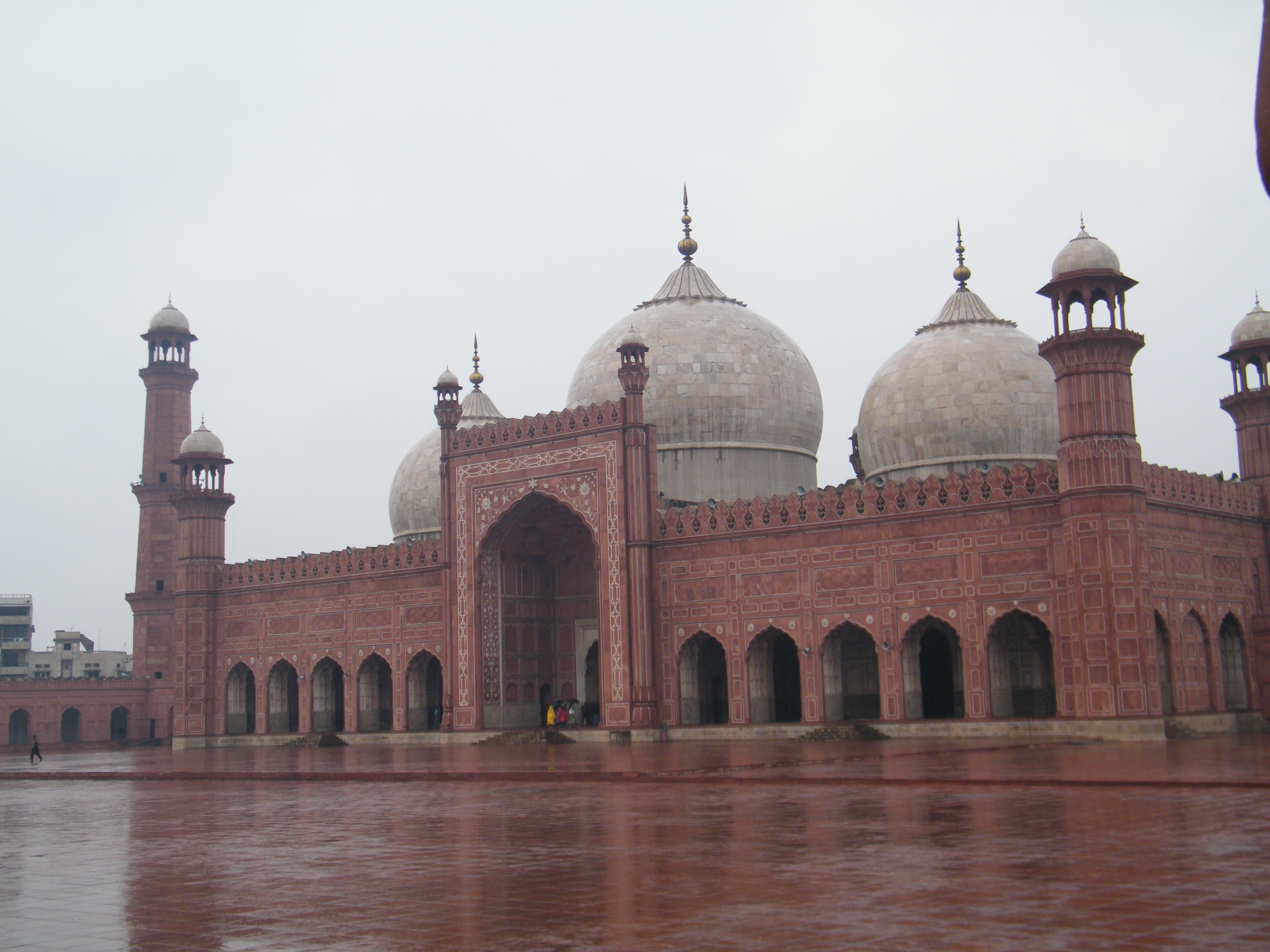
Here’s a confession: I have been to Lahore a total of five times and only recently, on my fifth trip there, did I get round to visiting the Badshahi Mosque.  This is strange, seeing as it is one of the premier historical attractions of Pakistan and I am keenly interested in history.

Never mind, though – despite my tardiness I eventually got around to visiting it, and I wasn’t disappointed.  Its size alone makes it stand out – it is vast, with a courtyard large enough to accommodate some 95,000 worshippers.  It was the largest mosque in the world for over 300 years, until it was overtaken by the Faisal Mosque in Islamabad.

I don’t want to add much more – if you want to learn about it, head over to Wikipedia in the first instance – but I can confirm that it is large, beautiful, a remarkable piece of Moghul engineering, and that we were welcomed warmly when we visited.  Hopefully the above photo will speak for itself…

It gives me no pleasure to write negatively about Pakistan.  Far too many people do that already.  Scan the airwaves for articles about Pakistan and the overwhelming majority will be negative.  In fact I can predict with some confidence the kind of phrases you are almost guaranteed to read: failed state, nuclear weapons, terrorism, sectarian conflict, human rights abuses.  What bothers me is not that these things are untrue – there is some truth in them, at least – but that they represent only one side of Pakistan.

Yet despite my fondness for the country I have come to call home I cannot deny that inequality is one of the most visible aspects of life here.  In Pakistan I have visited the homes of the wealthy, with air conditioning in every room, paintings on the walls, crystal glasses, fine china, and luxury food three times a day.  I have also visited the homes of the poor, mere shacks of battered brick propped up with planks of wood, where dinner is cooked over a cow-dung fire.  And I have seen homes even more impoverished than that: the shacks of canvas and cardboard which shelter the masses of shivering refugees from Afghanistan, Baluchistan, the tribal areas.

In Pakistan luxurious Toyota trucks with sparkling paint drive past children begging for rupees at traffic intersections.  The homeless sleep on pavements, huddled in thin blankets, while the children of the wealthy walk past to their expensive schools, dressed in crisply-ironed uniforms.  The wealthy splash thousands of rupees on dinner at one of the seven restaurants in the Islamabad Marriott while outside the homeless eke out an existence on the grace of others.

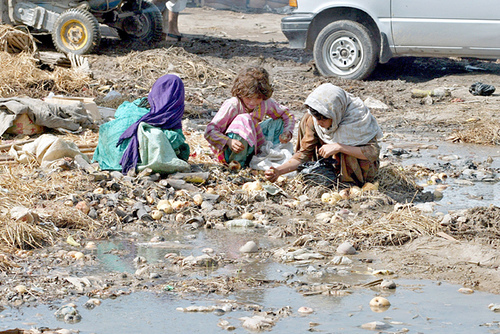
A friend who works in northern Pakistan commented that when he takes his household trash to the dump he is followed by gangs of children who fight over what his family throws away.  Once, in Murree, I was so moved by the street kids who followed me around begging for food that I handed over the can of Coke I was about to drink – only to see them fight for it viciously.

Inequality exists everywhere; we live in a world in which billions of dollars is spent on dog food in the West while children starve to death in Bangladesh and Mongolia.  But it feels more stark in the developing world.  Perhaps welfare softens the starkness of inequality in the West, while the absence of state welfare over here means that the poor really are wretchedly poor.

What’s a Christian to do?  We can’t ignore it.  We can’t do nothing.  But the task seems too great for any personal effort to make a tangible difference.  “Be the change that you want to see in the world” said a famous South Asian, Mahatma Gandhi – not a bad place to start, I suppose.

 Hold on tight, here comes a comment which is Completely Blindingly Obvious: Pakistan is a very religious country.

Image

 Not much of a surprise, is it?  Pakistan was the first Islamic state ever founded, carved out of British India by the iron will of Mohammed Ali Jinnah and set up as a homeland for the Muslims of the subcontinent.  Muslims from across India moved here, fearing for their future in a Hindu-majority country, while Hindus and Sikhs living in what was about to become Pakistan flooded the other way.  Right from the outset Pakistan’s identity was defined by the religious persuasion of the overwhelming majority of its inhabitants.

 And this religious identity runs even deeper than that.  Pakistan is a pretty loose-knit country, consisting of a range of ethnicities with not a whole lot in common: Punjabis, Pakhtuns, Baluchis, Sindhis, Kashmiris, people from the Northern Areas, and then a whole new group of Mohajirs – refugees who fled here from India and made a new life for themselves.  In my experience these groups have only a few things in common: hospitality, the ability to cook amazingly good food, a distrust of India, and Islam.  And even the Hindu and Christian minorities, about whom I will write in greater length another time, are deeply religious.  Early on in our time here I tried to explain to someone that modern Britain is a mostly secular country – but trying to translate “atheist” into Urdu proved tricky; nobody really knew how to say it, so we ended up by using the word “pagan” which is not really the same.

 See?  Pakistan is a country which has no comprehension of the word “atheist”.  It’s probably like trying to explain to a man living in the Gobi desert what snow is like.

 This identity affects more or less every sphere of Pakistani life.  The daily routine is punctuated by the call to prayer which echoes out at defined intervals.  Friday, the holiest day, sees most shops shut.  If you ask someone how they are they will probably respond “thanks to God, I am well”.  Everything has religious names – shops might be called “Bismillah Drinks Stall” (Bismillah means In the Name of God) or “Praise God Chicken Shop”.  I once bought some house plants from a guy in the bazaar who prefaced every single comment he made with the phrase “Insha’allah”, which made for a slightly odd conversation:

 Me: How much is that one?

Salesman: God willing, it is two hundred rupees.

Me: And that other one?

Salesman: God willing, it is only one hundred and fifty.

Me: Ok, I’ll have that one and that one.

Salesman: God willing, that is ok.

Me: How much does it come to?

Salesman: God willing, three hundred and fifty rupees.  But, God willing, as you are a guest, I will make it three hundred.

 And so on.

 There are two points I particularly want to make.  Firstly, the vast majority of Muslims I meet here are charming and polite in the way they present their religion.  Of course, there are different faces of Islam in Pakistan – there are groups who will murder Shi’a people because their interpretation of Islam differs from their own, for example – but every Muslim I have met has been polite, interested, and sincere.  I’m a Christian, so they disagree with me, but they do so nicely.

 And the second point is this: I like the religiosity of Pakistan.  I like that religion is a big deal here, because it’s a big deal with me.  I like the fact that I can walk into the bazaar and have a conversation about religion with just about any stranger I meet.  Modern Britain is so aggressively secular that any mention of religion marks you out as some kind of weirdo; received wisdom is that religion is dangerous, warlike and retrograde.  Over here, by contrast, everyone talks about religion, among most Pakistanis there is an ingrained respect for faith, and generally it is peaceable.

 There are exceptions, of course.  I’ll write about those later.  But the broad picture is probably a lot more pleasant than you’d think from reading the Western media.  As a Christian I much prefer a country which writes “Praise God” on its buses to one which writes “There is probably no God, so stop worrying”…

Image

“Of course, the thing I most object to in their religion is the violence of it” said one man to the other.  “It seems that they are unable to express their religious views without killing people who disagree with them.”

 “I agree” said the second man to the first, stroking his beard pensively.  “Their track record of combining their faith with military power speaks for itself.  They claim that theirs is a religion of peace and yet we see them attacking others, declaring war, and invading foreign countries in the name of their God”.

 “Not to mention persecuting people of their own faith whose interpretation of their scriptures differs from their own!” added the first man angrily.

 Both men paused to reflect.

 “And then there’s the fact that they always break their word.  They make treaties with their enemies and then break them.  Always have done, always will.  Can’t trust anyone from that religion, history proves that quite well” snorted the second man.

 “And don’t even get me started on their contempt for science and progress” said the first man, stabbing the air with an enraged finger to emphasise his point.  “The way they persecuted scientists and constantly stand in the way of progress and development.  Some of the poorest countries in the world are based on their religion”.

 “Too true, too true” confirmed the second man sadly.

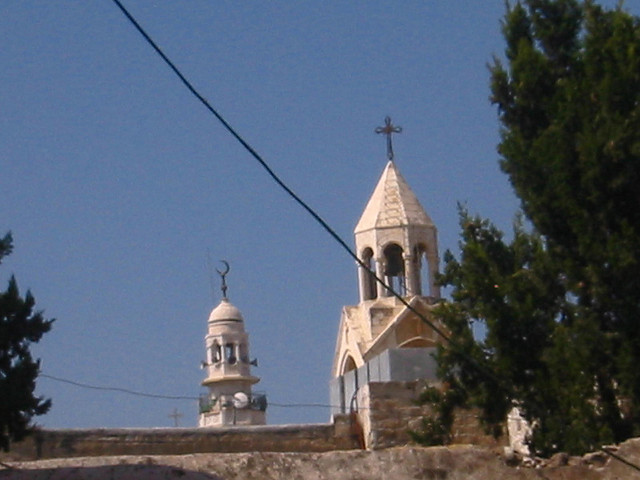
 “Listen to that, the sound of their religious building calling the faithful to prayer” said the first man.

 Both men stopped to listen to the noise of the church bells tolling.  The sound, mournful and plangent, echoed from the top of the church tower.  They listened sadly, then sat in thoughtful silence as the sound of Christian worship throbbed from the church.

 “The thing is, though” said the first man quietly, “I can’t stop thinking about that Jesus of theirs.”

 Another pause, then:

 “If only they behaved more like him”.

 A wise man once said that the whole point of travel is not to set foot on foreign land, it is to at last set foot on one’s own country as if it were foreign land.  After a couple of years of living in Pakistan, together with a couple of trips back to my home country, that feels about right.

 We enjoy being in Pakistan, but we look forward to going back to the UK for a break.  We think that it will be familiar, comprehensible, somehow easier.  We look forward to coffee shops and country pubs and not being stared at when we go outside.  And those things are nice.  But what I didn’t expect is that the UK doesn’t really feel like home any more.  Wandering around my home town it felt odd that people didn’t greet each other politely like they do in Pakistan.  They seemed too busy rushing from place to place, towing their children behind them like suitcases.  The weather felt odd, the roads felt odd, people seemed to behave oddly.  Nobody honked their horns, nobody argued, nobody waved at us across the street and shouted “salaam aleikum!”.

 Then we came back to Pakistan, and it doesn’t really feel like home either.  It’s dusty and noisy and everyone looks different from us and, despite our best efforts, our Urdu is still not good enough to make ourselves understood perfectly.  People here are friendly and polite and welcoming, but it’s still foreign.

 Everywhere’s foreign now.  If that’s the point of travelling, then we’ve achieved it.  Great.  But we still feel like aliens.  Maybe that’s a good thing for a Christian.  After all, everywhere on earth is a temporary residence for a Christian.  Perhaps we won’t ever feel truly at home until we get there.

The film protests seemed to make people around the world think that Pakistanis are inherently angry people.  Such a small issue, they said, and such a disproportionate response!  The days of rioting seemed to confirm their suspicions that the population of Pakistan consisted of mainly angry people and religious fundamentalists, many of whom were also pretty angry.

I disagree.  The thing which strikes me most about Pakistani people is how hospitable and friendly they are.  I was struck by this when I arrived here and it continues to have an impact on me, more or less every day: when shopkeepers offer to buy me drinks and chat, when taxi-drivers and samosa-sellers try to refuse my money, when just about every man I meet in the bazaar engages me in polite and interested conversation.

Image

The amazing thing about this is that Pakistanis have every reason to dislike and distrust foreigners.  The land which is now Pakistan has been invaded by just about every military conqueror that history has to show: Alexander the Great, the early armies of Islam, the Afghans, the Persians, the Moghuls, and finally my ancestors, the British.  And even after that, when Pakistan was founded and people finally achieved their independence, the influence of world powers flowed across this land: the long proxy way against the Russians in Afghanistan and then the Americans, with their counter-terrorist operations and their drone strikes.

Think about it: if your country had lived through all of that, wouldn’t you be suspicious of outsiders?  And if those same outsiders were still bombing targets within your country, free from any restraint imposed by international law, mightn’t you be a bit angry?

But no, Pakistanis are invariably polite, welcoming and hospitable, despite the fact that foreigners have been meddling in their affairs for about two thousand years.  Angry Pakistan?  Painfully Polite Pakistan, more like.

Image

The TV screen caught my eye.  We were in a restaurant eating some delicious Pakistani food but suddenly the images of protesters waving placards and storming into embassies grabbed my attention.  Protesters in the Middle East had attacked US embassies in the Middle East in response to an amateur film which was critical of Islam and its prophet.  My first thought was whether the protests would spread further.

“Oh, don’t worry” said a passing waiter in response to my anxious question.  “People here aren’t too bothered about it”.

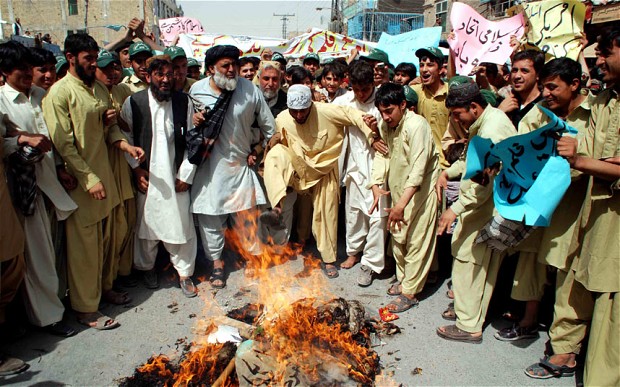
Well, he was wrong.  Boy, was he ever wrong.  A few days later protests exploded all over Pakistan.  Cinemas were burned, mobs roamed the streets stoning cars and attacking the police, and a large crowd attempted to storm the US embassy in Islamabad.  Our whole family stayed inside the house for four days.  Over twenty people were killed, largely in the southern megacity of Karachi.

These protests were criticised heavily, both within Pakistan and internationally.  Certainly, it is hard to see how torching a cinema and thereby destroying the livelihoods of many people is a valid way of expressing discontent.  They also seemed disproportionate to some – how could an amateur film, shoddily made in California on a tiny budget, possibly merit a response of such violence, a response which locked down Pakistan’s major cities for three days and which led to the deaths of so many people?

What people in the West largely fail to appreciate is that there is a lot of latent anger within Pakistan.  People here are angry about a whole range of issues.  Resources such as electricity, water and gas are limited.  Jobs are limited.  The population is growing rapidly and the pressure on both resources and jobs is increasing.  Prices are increasingly rapidly and salaries are not keeping pace.  Furthermore, it is widely recognised that Pakistan’s leaders are corrupt, with Transparency International claiming that $94 billion (yes, billion) have been lost due to corruption within the last four years.  People know this, and they also know that there’s not much they can do about it, and if I were in their shoes that knowledge would make me very angry indeed.

So yes, these protests were about the film, but the violent and angry response we all saw on our TV screens runs a lot deeper than that.  Lots of people here are angry and afraid.  When I caught up with a friend recently I asked him about how he saw things in Pakistan.  His response saddened me.  “Everyone here feels mental depression.  Some people can barely afford to eat.  Are you surprised that we are so angry?”.

Image

One of the challenges facing any Westerner living in Pakistan is dealing with poverty.  The difference in living conditions between us and a large chunk, even a majority, of the people we meet here presents a number of difficulties.  Of course, this is not specific to Pakistan – any person travelling from the West to any relatively impoverished country will come across poverty, such is the gulf between “the West” and “the rest” when it comes to wealth.

For me, this gulf was most starkly brought home when, early on, I was driving through our city with the kids in the back of the car.  Beggars regularly haunt traffic intersections, tapping on car windows and asking for money.  One of them, a young girl, pressed her nose up against the window where our 2 year old son was sitting.  It occurred to me that only a thin piece of glass separated them – but the gap between them in terms of wealth, life expectancy, job prospects, overall prosperity, in short every measure of quality of life – that gap was immense.  One child can expect little more than a lifetime of poverty and hardship, forced to eke out a living from the scraps of others, while the other child, possessed as he is of a Western passport, can expect a lifetime of relative comfort and entitlement.  A few millimetres of glass represented, for a few fleeting seconds, a division of heartbreaking width.

What’s a Christian to do?  This is not at all an easy question and it weighs heavily on the conscience.  While I cannot offer an easy answer, some pointers might be of use.

1. Doing nothing is not an option.  Christians are called to minister to the needs of others and in this regard we have the example of Jesus who constantly ministered to those in need.  If we simply turn our back and ignore the plight of the needy then our faith is nothing but tedious hypocrisy.  Poor people can’t eat sermons; holy words don’t put a roof over their heads.

2. Handing out money is not the answer.  This is an easy way out, enabling the wealthy to assuage their consciences by dishing out a few rupees here and there.  In doing so we effectively purchase for ourselves a few minutes of peace of mind, happy that we have done “something” for “someone”.  Well, maybe we have, and maybe we haven’t.  Those rupees may mean that a beggar eats, or they may mean that their gangmaster makes even more money for himself.  Sad, but true in many parts of the world.

3. Love and respect are worth more than money.  I try to chat to people begging from me, asking them what their name is and engaging them in conversation.  Sometimes they don’t care, eager only for money, but on a few occasions their faces have lit up as they discover that someone sees them as a precious human being rather than just an irritation.

4. Word and deed need to go together.  As I said before, mere words do not fill empty stomachs.  We try to hand out little packets of biscuits as well; at least the beggar will be able to have a little something to eat.

Ultimately it is the root causes of poverty which need to be tackled.  It is not the fact that kids beg at traffic intersections which really angers me, it is the brokenness in human institutions and societies which results in kids having to beg at traffic intersections.  Many of the beggars in our city have fled from warfare in the tribal regions; others are destitute because rich landowners throw them out or are so greedy for money that they loan money at prohibitive interest rates, resulting in entire families being forced onto the poverty line so that a rich man can build a bigger house.  This problem has to be tackled wholistically, taking the whole situation into consideration.

Martin Luther King once said that the essence of Christian love was to pick people out of ditches and set them back on their feet – and, eventually, to tackle the injustices which result in people being throw in the ditch.  We need to do both.  It’s a big job, but thankfully we have a big God, too.

Since I am the son of a vicar – the son of a vicar married to a vicar, indeed, since the Church of England started ordaining women – you might think that I’m a Christian simply out of force of habit.  I’ve been going to church every Sunday my whole life, so it might be thought that as I became an adult I simply carried on in the same way.

But that’s not why I believe.  I’m too rebelllious and stubborn, too keen to do things my own way, for that to be true.

It might also be thought that I’m a Christian because I was born and brought up in a Christian country, that the faith which shaped Britain also shaped me.  But that’s not it either.  Britain’s not a Christian country, never really has been a thoroughly Christian country, and I’m not sufficiently sheep-like blindly to follow the faith of my compatriots.

You might even think that I’m a Christian because I like Christianity, or because Christians are better people than non-Christians, but that’s not always true, and therefore isn’t really a good enough reason on its own.

The reason I believe is because, simply, nothing in religion, nothing in philosophy, not a single thing in the history of this world compares to Jesus.  Here is a man who claimed to be God, who instructed his followers to forgive their enemies, who loved everyone, who valued the people who have always been rejected and scorned by men, a man so compelling that people would hack through a ceiling in order to get closer to him.  The more I read about Jesus the more dumbstruck I feel at the beauty of his teachings.  The more dumbstruck I feel, the more insistent I feel that others should have a chance to hear about him too.  Jesus, for me, is the approachable face of the God who simply has to exist in order for human existence to have a meaning.

There’s a lot more that I could write but I’m keen to keep this simple.  My Christian faith does not make everything easy, does not always provide answers to difficult questions, and does not mean that I wander through life with an smug smile on my face and a stock of glib answers in my pocket, like some kind of religious double-glazing salesman.  But it does give me a reason to be hopeful, to be joyful, to believe that peoples’ lives can be turned around and that there is an alternative to the brokenness that is so agonizingly evident in the human world.

Oh, and it doesn’t mean that I like Christian rap music, before you ask.

Design a site like this with WordPress.com
Get started